
- All
- Product Name
- Product Keyword
- Product Model
- Product Summary
- Product Description
- Multi Field Search
Views: 0 Author: Site Editor Publish Time: 2026-08-31 Origin: Site


Transitioning from manual to automated end-of-line packaging hinges on a critical technical question. Can a collaborative robot accurately execute your specific stacking configurations? Hand-stacking often leads to errors. Inconsistent stacking ruins pallet geometry. Compromised load stability delays shipping and damages products. Handling mixed SKUs or specific label orientations creates severe bottlenecks when evaluating automation.
Modern cobot palletizing software solves these exact issues. It has evolved significantly over the last decade. Facilities no longer rely on rigid waypoint programming. Instead, they use dynamic pattern generation driven by smart software. This guide breaks down exactly what patterns a cobot can handle. We will explore payload realities and specific orientation controls in detail. You will learn the exact criteria required to evaluate automation feasibility for your facility.
Versatility: Modern cobot palletizers handle all standard configurations, including columnar, interlocking, pinwheel, and chimney patterns, without requiring complex coding.
Payload Realities: A 20KG case carton cobot can manage heavy end-of-line tasks, but true payload capacity must account for end-of-arm tooling (EOAT) weight and operating speeds.
Orientation Control: Integrating a cobot palletizer with label function ensures barcodes face outward on the pallet, though this requires specific EOAT design and slightly impacts cycle times.
Software Reliance: Execution relies entirely on palletizing-specific software platforms that auto-calculate optimal patterns based on box dimensions and slip-sheet requirements.
Cobots execute various geometries precisely. They follow distinct spatial logic to build sturdy loads. Operators need to match the load type to the right stacking method. Different boxes demand different architectural approaches. We categorize these into three main structural types.
Boxes stack directly on top of each other. The corners align perfectly from the bottom tier to the top. Vertical strength remains incredibly high here. Corrugated boxes support the most weight directly at their vertical corners.
Implementation Reality: This method offers the absolute fastest cycle time. The robot moves minimally between drop positions. It repeats the exact same X and Y coordinates for every layer. However, column stacking offers the lowest lateral load stability. Columns easily tip during forklift transport. You usually require slip sheets between every few layers to bind the columns. Operators must apply stretch wrap immediately for transit stability. Missing this step guarantees load failure.
This pattern alternates layer directions. It ties the entire load together seamlessly. One layer faces north-south. The next layer faces east-west. This overlapping creates friction and immense structural integrity.
Implementation Reality: This stands as the industry standard for a Cases Boxes Palletizing Cobot. The system must mirror and rotate coordinates for every alternating layer. Complex algorithms handle these calculations automatically in the background. The robot precisely rotates the end-of-arm tooling before placing the carton. It aligns each box to lock the layer below it securely. Your box dimensions must allow for interlocking mathematical ratios.
Certain products need constant airflow. Chimney patterns leave central voids open deliberately. These gaps provide vital ventilation through the pallet center. Cold chain logistics and fresh produce operations rely heavily on this configuration.
Implementation Reality: Modern software configures these gaps easily. You simply define the spacing parameters inside the user interface. However, it requires highly precise box-dimension inputs. Inaccurate measurements cause overhang into the chimney void. Too much gap leads to inner pallet collapse. You must test the physical layout manually before finalizing the program.
Table: Pallet Pattern Stability Comparison
Pattern Type | Lateral Stability | Vertical Crush Resistance | Cycle Time Impact | Ideal Application |
|---|---|---|---|---|
Column (Block) | Low | Maximum | Fastest | Heavy goods requiring fast cycles (needs wrap) |
Interlocking | Maximum | Moderate | Average | Standard retail cartons and mixed transit |
Pinwheel | High | Moderate | Average | Square pallets needing internal binding |
Chimney | Moderate | Low | Slower | Cold chain, produce, and ventilated goods |
How does the machine know exactly where to put the carton? Ease of deployment relies on intelligent programming environments. We see a major shift in modern manufacturing facilities.
Historically, industrial robots required highly trained engineers. They had to program every single drop point manually. We call these positions waypoints. A pallet holding 150 boxes needed 150 individually programmed waypoints. It took days to set up one product line. Modification required starting over.
Today, the setup process is entirely parametric. Operators input box dimensions, weight, and the physical pallet size. They specify the desired layout visually on a touch screen. The software engine auto-generates the cobot palletizer pallet patterns instantly. The mathematical logic lives inside the software controller. It computes collision-free trajectories automatically. It avoids singularities and joint limits without human intervention.
Can the cobot build a load slightly larger than the wooden base? Or smaller? This represents a common evaluation constraint. Physical pallets measure standard sizes globally. Sometimes product packaging does not fit this footprint perfectly.
Risk Consideration: Overhang limits rely strictly on the physical reach envelope. Typical arms feature 1300mm to 1700mm reach limits. If a box hangs over the edge, the arm must reach further outward. The base joint might hit a mathematical singularity point. The robot simply stops moving. Underhang creates a different problem altogether. It reduces the base stability of the entire stack. Always check the maximum reach radius in your 3D digital simulation.
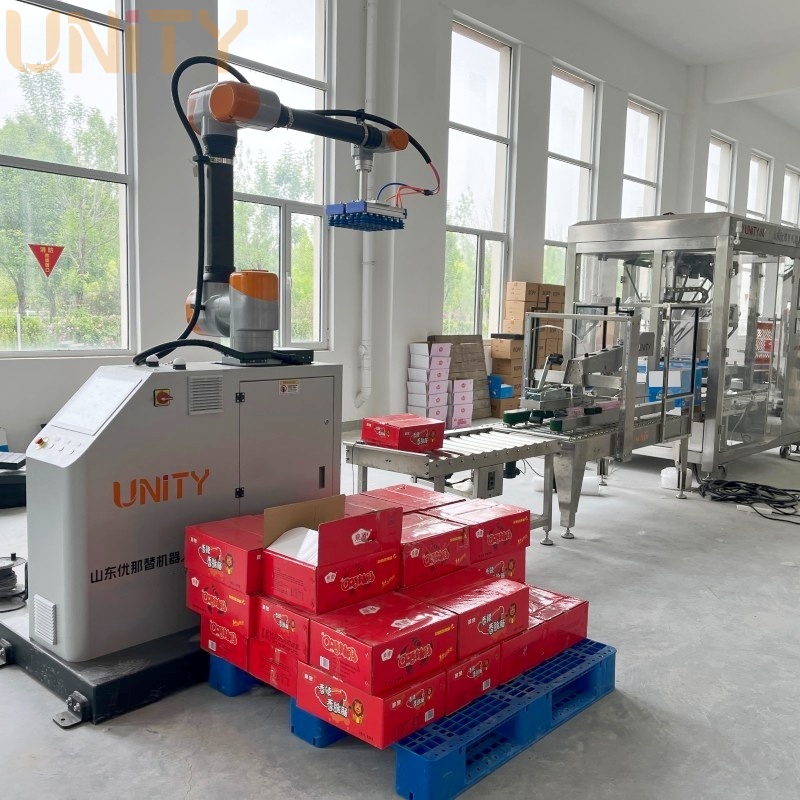
Heavy payload constraints dictate hardware choices directly. Cycle-time trade-offs happen constantly in automation planning. You must evaluate physical limits objectively to ensure system longevity.
A 20kg rated system does not actually lift a 20kg box. This is a crucial distinction for buyers. You must deduct the weight of the gripper itself. End-of-arm tooling includes vacuum foam pads or heavy pneumatic clamps. Tooling brackets, valves, and sensors add considerable mass. This equipment usually weighs between 2kg and 4kg.
Therefore, a 20KG Case Carton Cobot safely handles a 16kg or 17kg payload. Pushing beyond this triggers protective motor stops. You must weigh your heaviest carton accurately on a scale. Include the product, the internal dunnage, and the outer packaging material.
Physics play a massive role here. Swinging a near-capacity load generates high inertia. The robot must move slower to maintain its collaborative safety ratings. Fast, heavy movements cause emergency stops. Joint torque limits trigger controller errors to protect the gearboxes.
Decision Criteria: Do you need 15 boxes per minute at 20kg? A collaborative system may not be the right fit. An industrial enclosed cell handles higher speeds better. Cobots excel at 6 to 10 boxes per minute. They prioritize human safety and deployment flexibility over raw speed. Lowering the speed prevents excess wear on the mechanical joints.
Key factors affecting your actual cycle time include:
Total box weight relative to the true payload limit.
Physical distance between the infeed conveyor and the pallet center.
Complexity of the chosen gripping mechanism.
Air pressure availability for vacuum generation tools.
Vertical travel distance required for the highest tiers.
Retail distribution centers demand specific label orientations. Solving this complex requirement takes careful mechanical planning.
Warehouses require barcodes to face outward for optical scanning. Forklift operators scan pallets directly from the aisle. This disrupts standard interlocking patterns entirely. The robot must rotate specific boxes 90 or 180 degrees before placement. If the box is rectangular, rotation changes the layer geometry completely. The software must recalculate the entire grid to accommodate this shift.
Many facilities print labels on demand at the end of the line. Using a Cobot Palletizer with Label Function involves integrating a secondary print-and-apply station. The process follows a very specific sequence.
The cobot picks the unmarked box from the infeed conveyor.
The arm moves the box over a stationary label applicator.
The applicator stamps the barcode onto the designated cardboard panel.
The arm rotates the box to face the outside edge of the pallet.
The cobot places the newly labeled box securely onto the stack.
Implementation Risk: Performing 180-degree rotations increases cycle time. Secondary stops at a labeler add 1 to 3 seconds per pick. You must factor this delay into your production throughput targets. Labeler integration demands seamless electrical communication. Handshake signals between the robot controller and the printer are mandatory to prevent collisions.
Evaluating automation requires a strict evaluation checklist. Buyers must shortlist equipment based on factual operational data rather than assumptions.
SKU Mix: Do you run consistent box sizes per pallet, or mixed-SKU pallets? Mixed-SKU environments require advanced 3D vision systems, not just standard pattern software. Standard parametric software handles one box size per pallet brilliantly.
Throughput Limits: Does your pattern require speeds exceeding 8 to 10 picks per minute? Collaborative arms prioritize safety monitoring. High-speed lines often overwhelm their joint limits. You might need dual infeed conveyors to maximize pick efficiency.
Reach Height: Does your final pattern exceed 1.5 meters? High stacks pose a severe physical challenge. The arm cannot reach the top tier natively. If so, your setup requires an automated lifting column. This 7th axis raises the entire robot base vertically during the cycle.
Packaging Quality: Are your boxes fully sealed and rigid? Flapping packing tape destroys vacuum gripper reliability. Unsealed tops cause immediate suction leaks. The robot will drop the box mid-air. Ensure your case erectors and tapers function perfectly before deploying robotic lifting.
Following this checklist prevents costly deployment failures. It highlights the exact mechanical realities of your packaging line. You can address poor tape quality or extreme heights before purchasing hardware.
Collaborative palletizers can handle virtually any pattern a human can build. The parametric software must be highly capable. The physical reach envelope must support your specific pallet dimensions. Geometry and physics dictate your ultimate success. A proper interlocking configuration ensures safe transit for your goods.
The most reliable way to verify feasibility is proactive planning. Request a digital twin simulation from your systems integrator. Supply your precise box dimensions, weight limits, and cycle time goals. Integrators will output a verified cycle-time report using 3D modeling. You can review this concrete data before any capital is spent. Taking this step eliminates guesswork and ensures a smooth operational launch.
A: Yes. Most systems use a dual-function EOAT. The tooling features vacuum cups for heavy boxes and smaller suction nodes for slip sheets. The software allows users to program a slip sheet drop after specific layer intervals. The robot picks the sheet from a nearby magazine and places it accurately.
A: Modern palletizing software stores digital recipes. An operator simply selects the new SKU recipe on the touch screen teach pendant. The system automatically updates the pattern without manual reprogramming. This immense flexibility makes cobots ideal for high-mix, low-volume production environments.
A: Yes, if the combined weight of the boxes and the EOAT falls within the maximum payload limit. For example, two 8kg boxes stay under a 20kg limit. The infeed conveyor must present the boxes consistently side-by-side. Multi-picking effectively doubles your throughput capacity without increasing robot speed.
A: By definition, cobots are designed to run fence-free. However, handling heavy loads at high speeds changes the facility risk profile. A 20kg carton moving quickly poses a blunt force hazard to operators. A formal risk assessment may still mandate area scanners or light curtains for strict compliance.


