
- All
- Product Name
- Product Keyword
- Product Model
- Product Summary
- Product Description
- Multi Field Search
Views: 0 Author: Site Editor Publish Time: 2026-07-27 Origin: Site


Manual palletizing introduces severe ergonomic liabilities to your warehouse workforce. It also creates sudden throughput bottlenecks and heavy labor dependency. These are critical vulnerabilities in modern continuous-production environments. Transitioning to automated end-of-line packaging is no longer just a labor-saving measure. It is a baseline requirement for operational scalability and survival.
However, effective implementation goes beyond simply buying a standard robot. You must match the robotic architecture and End-of-Arm Tooling (EOAT) to your facility's unique environment. Your product's physical handling constraints dictate every hardware decision. Getting this wrong leads to endless maintenance cycles and dropped products.
This guide breaks down specific Robotic Palletizing Applications across three highly demanding sectors. You will learn the exact technical criteria required for successful deployment. We will explore how smart hardware choices drastically improve your line's long-term reliability.
Food & Feed: Systems require strict dust mitigation and specialized handling for pliable packaging (e.g., flour and feed bags) without compromising product integrity.
Chemicals: Safety and compliance dictate the use of IP-rated, corrosion-resistant robots capable of handling hazardous materials in varied packaging formats.
Building Materials: High-payload capacities and extreme abrasion resistance are non-negotiable for handling dense, heavy products like cement.
Evaluation Rule: Successful adoption hinges on aligning payload, Bags Per Minute (BPM), footprint, and EOAT design with your specific operational realities and integration risks.
Generic, off-the-shelf palletizing solutions often fail completely in harsh industrial environments. Facility managers frequently buy standard robots assuming they can handle any simple lifting task. They quickly discover inadequate environmental protection destroys internal motors. Furthermore, mismatched gripper designs routinely drop or puncture fragile packaging. You cannot force a one-size-fits-all automation cell into a specialized production line.
A viable robotic integration must demonstrate measurable improvements across specific operational metrics. If the hardware does not improve these baseline targets, the integration is flawed. You should expect clear upgrades in three critical areas:
Consistent Throughput: The robot must maintain strict cycle times without causing upstream production jams.
Reduced Injury Claims: Automation must directly lower worker compensation claims by removing repetitive, heavy lifting tasks.
Minimal Unplanned Maintenance: The hardware should run continuously between scheduled service intervals without sudden breakdowns.
The physical characteristics of your product must dictate your robotic hardware selection. Temperature fluctuations, abrasive dust, toxicity, and material deformability change how a robot operates. You must customize the End-of-Arm Tooling to grab items securely without causing damage. You must specify appropriate IP ratings to protect delicate joints from airborne particulates. Ignoring product realities during the design phase guarantees system failure. We strongly advise mapping out every physical product quirk before discussing hardware options.
Operating in food and agriculture presents a unique set of material handling hurdles. Your core challenge involves managing high volumes of airborne particulates. Dust settles on sensors and clogs poorly sealed joints. You also face the difficult task of handling non-rigid, easily punctured packaging. Pliable bags shift constantly during movement. You must control them perfectly to avoid product loss or dangerous pallet instability.
Flour production environments require highly specialized equipment due to combustible dust and shifting product weights. Integrating a dedicated flour bag palletizer demands strict attention to EOAT design and layer building. These systems require advanced slip-sheet handling capabilities to prevent ground moisture ingress. Placing a protective barrier between the wooden pallet and the first layer of flour is mandatory for food safety.
Standard vacuum grippers often fail here. Flour bags are porous and highly flexible. This application demands specialized bag grippers. Clam-shell mechanisms or soft-touch finger grippers are industry standards for this task. They cradle the bag from underneath. This support maintains the bag's shape for stable, square stacking. Dropping a poorly supported bag causes the flour to settle unevenly, ruining the pallet structure.
Animal feed lines introduce intense variability into the palletizing process. A robust feed bag palletizer must accommodate rapidly shifting bag weights. It also needs to handle varying centers of gravity. Pelleted feed settles differently than powdered feed during transit. The robotic arm must calculate these dynamic shifts to place bags precisely.
Sanitation is another non-negotiable factor. Equipment must meet strict food safety standards. You must ensure washdown-ready components are heavily featured in your system design. Minimum IP67-rated joints allow your sanitation crew to use high-pressure water and cleaning chemicals safely. Without adequate ingress protection, routine cleaning will destroy the robot's servo motors.
Achieving maximum stability requires precise programming for overlapping stack patterns. When pliable bags shift and settle on a pallet, they can easily cause column collapse. We program the robot to interlock layers, much like laying bricks. This alternating pattern ensures ultimate pallet stability during rough transit. A common mistake is using column-stacking for non-rigid bags; this almost always leads to tipped loads in the delivery truck.
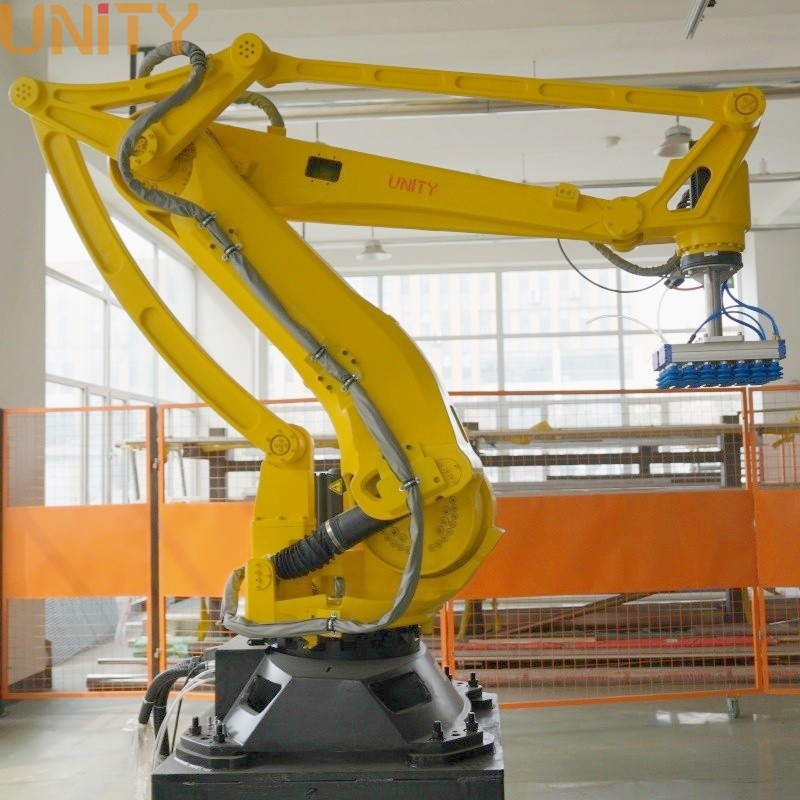
The chemical industry introduces extreme risks to both personnel and machinery. Operator safety and toxic exposure prevention become your primary objectives. Handling highly variable, rigid packaging requires immense versatility. Facilities routinely switch between drums, pails, FIBCs, and heavy-duty bags. A rigid, inflexible automation cell cannot survive in this environment.
When selecting a chemical bag palletizer, you must prioritize environmental resilience. Volatile atmospheres demand the integration of intrinsically safe or explosion-proof robotic arms. ATEX certification is often required by law where combustible fumes or dust exist. These specialized robots prevent electrical arcing from igniting the surrounding atmosphere.
Caustic airborne chemicals eat through standard paint and exposed wiring in months. You must specify corrosion-resistant coatings for all exposed metal surfaces. Sealed mechanics protect internal gearing from acidic degradation. Standard industrial robots will rapidly deteriorate if deployed in chemical manufacturing environments without these specialized protective upgrades.
Packaging formats change frequently in chemical plants. You need versatile payload handling to maintain efficiency.
Vacuum Grippers: We heavily utilize vacuum grippers for sealed chemical bags. They provide a firm hold on smooth, non-porous plastics without piercing the material.
Quick-Change EOAT: You should implement automatic tool changers. This allows the robot to seamlessly transition between grabbing bags and hoisting heavy drums.
Custom Tooling: Hybrid grippers can combine vacuum cups for bags and mechanical clamps for pails in a single unit.
Automated handling entirely eliminates the risk of human exposure to dangerous chemical spills. Manual lifters occasionally drop or puncture materials due to fatigue. A robot does not suffer from fatigue. It executes precise movements every single cycle. This predictability drastically lowers your facility's environmental contamination risks and protects your human workforce from toxic exposure.
Hardware Comparison: Standard vs. Chemical-Grade Palletizers
Feature | Standard Industrial Robot | Chemical-Grade Robot |
|---|---|---|
Paint & Coating | Standard epoxy | Anti-corrosion, chemical-resistant coating |
Safety Certification | General industrial standards | ATEX or intrinsically safe certified |
Wiring & Cables | Exposed routing | Internally routed, chemically sealed cables |
Joint Protection | IP54 to IP65 | IP67 minimum, often pressurized |
The building materials sector is notoriously punishing on machinery. Your core challenge involves managing extreme payload requirements simultaneously with highly abrasive environments. Silica and aggregate dust act like sandpaper on moving parts. You must design a system that survives continuous, grueling cycle times without faltering.
A reliable cement bag palletizer requires massive structural integrity. You need heavy-duty robotic arms with payload capacities well exceeding 100kg. This allows the robot to handle multiple bags per cycle, maximizing throughput. High payload capabilities also reduce wear and tear on the arm by keeping it well below its maximum stress threshold.
Vacuum grippers fail miserably in cement applications because dust instantly clogs the suction filters. You need mechanically robust bag grippers. Finger grippers or clam-shell mechanisms are designed to withstand constant exposure to abrasive cement dust without jamming. They grab the bag physically, bypassing the need for clean air suction.
You must also protect the robot itself from the environment. Pressurized robotic jackets are frequently used in these facilities. By pumping clean air into a sealed jacket, you create positive pressure. This positive pressure actively pushes abrasive particulate away from the robot. Specialized labyrinth seals prevent dust ingress into critical joints and servo motors.
Cement bags hold trapped air, making them resemble balloons when they exit the filling station. Palletizing rounded bags creates highly unstable, dangerous loads. We highly recommend integrating bag-flattening conveyors pre-palletization.
Flatteners press out trapped air before the robot grabs the bag.
This creates flat, uniform layers.
Uniform layers ensure maximum pallet density and safety during forklift transport.
Skipping this step is a common mistake that severely limits how high you can safely stack building materials.
Choosing the right hardware requires a calculated assessment of your production data. You cannot guess your specifications. You must evaluate your throughput, footprint constraints, and integration risks methodically.
Start by calculating your peak production rates in Bags Per Minute (BPM). You must design your system for your absolute peak times, not your daily average. If you run light loads at extreme speeds, you might need a high-speed SCARA or Delta robot. If you handle heavy payloads at moderate speeds, a 4-to-6 axis articulated robot is your best option. Overestimating payload while underestimating BPM leads to massive production bottlenecks.
Hardware Selection Chart based on Speed and Payload
Robot Type | Ideal Payload Range | Speed / Cycle Time | Best Application Fit |
|---|---|---|---|
Delta Robot | Under 10 kg | Ultra-High (100+ picks/min) | Primary food packaging, tiny boxes |
SCARA Robot | 10 kg - 20 kg | High (60-80 picks/min) | High-speed rigid box palletizing |
Collaborative (Cobot) | 10 kg - 35 kg | Low (Under 15 picks/min) | Fenceless setups, tight floor space |
4-to-6 Axis Articulated | 50 kg - 800+ kg | Medium (20-40 picks/min) | Heavy cement, chemical drums, flour bags |
The EOAT is the most important part of your system. You must assess whether vacuum, magnetic, fork, or clamp grippers best serve your primary product. Vacuum works for sealed plastics. Clamps work for heavy, dusty bags. Magnets work for metal pails. If your line handles all three, you must determine whether automatic tool changers are necessary. A tool changer adds upfront cost but provides incredible daily flexibility.
Floor space dictates your robot category. Traditional industrial robots operate at high speeds and demand large footprints. They require extensive safety fencing and light curtains to protect workers. If you lack floor space, you might consider Collaborative robots (Cobots). Cobots offer a smaller footprint and safe human interaction without heavy fencing. However, they suffer from heavily limited payloads and very slow speeds.
Finally, assess the WMS/ERP integration capabilities of the provided software. The palletizer needs to talk to your warehouse management system to print labels and log inventory. Risk note: Always factor in potential line downtime during installation. You must also account for the learning curve required for your maintenance staff to understand the new software interface.
Generic palletizing cells carry incredibly high failure rates when deployed in specialized industries. Long-term success requires strictly matching your hardware specs—including IP ratings, payload capacities, and EOAT design—to your material realities. You cannot ignore the presence of abrasive dust, corrosive chemicals, or shifting product weights. Taking shortcuts on customization will cripple your end-of-line efficiency.
Before requesting a quote, document your peak bags-per-minute (BPM), primary packaging types, and available floor space. This exact data allows integration engineers to design a system that works on day one. Do not rely on average production speeds; design for your heaviest shift.
Contact a specialized integration engineer today to conduct a thorough site audit. Ask them to run a complete 3D feasibility simulation for your specific product line to guarantee performance before you buy.
A: Most facilities observe an ROI between 18 to 30 months. This rapid return is primarily driven by immediate labor reallocation. You also save heavily on reduced injury claims and insurance premiums. Furthermore, the system provides continuous 24/7 operational capability, drastically increasing your overall weekly throughput.
A: A robotic arm may be configured to handle different packaging types when suitable grippers, tool changers, controls and product-detection systems are included. However, compatibility and changeover time depend on the differences between the bags, cartons, pails or drums, as well as the required payload and throughput. Some applications can use one flexible cell, while others may require separate tooling or dedicated palletizing systems.
A: They utilize heavily sealed, IP67-rated joints and pressurized physical covers. They also rely on mechanical clamps rather than purely vacuum-based grippers. Vacuum filters clog instantly in cement plants. Mechanical grippers prevent dust-related failures and ensure a tight hold on heavy bags.
A: Yes. Because bags shift and settle dynamically, the robot's software must calculate overlapping, interlocking layer patterns. Often, facilities install automated bag flatteners upstream. The robot then executes complex crisscross stacking patterns to ensure the pallet does not topple during forklift transport.


