
- All
- Product Name
- Product Keyword
- Product Model
- Product Summary
- Product Description
- Multi Field Search
Views: 0 Author: Site Editor Publish Time: 2026-07-15 Origin: Site


End-of-line packaging represents a major operational bottleneck for modern manufacturing facilities. Manual stacking remains highly labor-intensive and notoriously difficult to staff consistently. Workers face severe ergonomic risks daily. They perform repetitive heavy lifting, making them incredibly vulnerable to chronic musculoskeletal injuries and subsequent burnout. These combined factors frequently lead to costly staffing shortages and unpredictable shipping delays.
You can eliminate this bottleneck by transitioning from manual operations to automation. Implementing a fully integrated Robotic Palletizing Solution transforms your shipping department. It standardizes case stacking, protects your human workforce, and guarantees predictable daily output. We designed this article to move beyond basic equipment definitions. We provide a comprehensive framework to help you evaluate, size, and implement the precise system you need. You will learn how to align these automated structures perfectly against your specific facility constraints and aggressive throughput requirements.
A robotic palletizing solution integrates a robot arm, specialized end-of-arm tooling (EOAT), and software to automate the stacking of goods onto pallets.
Selecting the right system requires balancing throughput (cases per minute), payload capacity, and available floor space.
Decision-makers must choose between traditional industrial robots (high speed/payload) and collaborative robots (compact footprint/flexible deployment).
Successful implementation relies on precise integration with upstream conveyors and facility safety compliance.
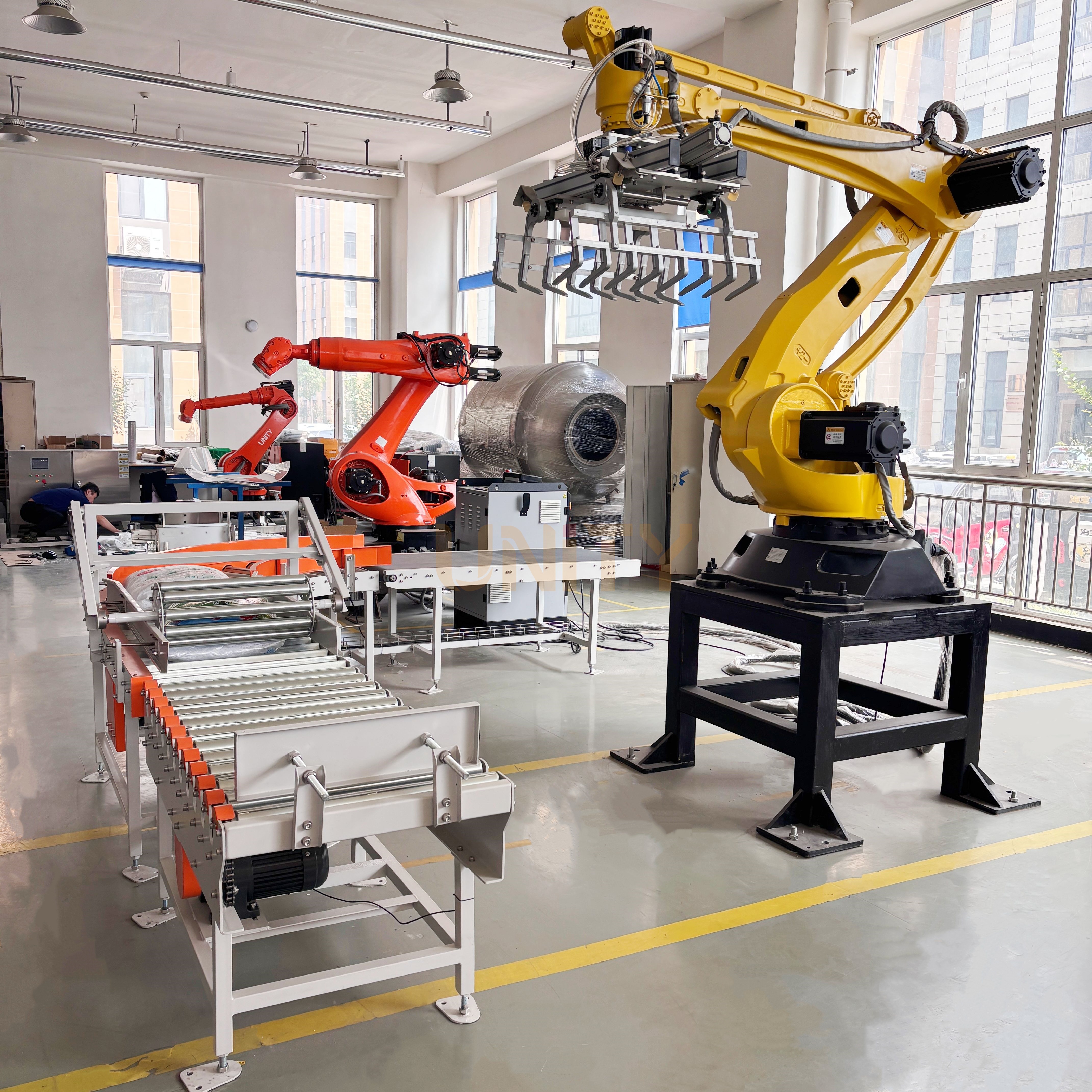
Every automated end-of-line system relies on a unified mechanical and digital architecture. Four main subsystems interact seamlessly to transport cases from moving conveyors onto stationary shipping platforms.
The robot arm serves as your central kinetic engine. It dictates essential metrics like maximum reach, absolute payload capabilities, and cycle times. Engineers categorize these mechanisms based on their inherent kinematic structure. Articulated units offer high flexibility across multiple axes. They bend freely to orient complex shapes. Cartesian gantries travel on rigid linear tracks. They cover massive work envelopes above multiple conveyor lines. SCARA configurations deliver extreme operational speeds for lighter loads. We evaluate these structures carefully. Choosing the correct kinematic profile ensures you hit target production speeds reliably.
The EOAT acts as the custom physical interface. It actually touches and manipulates your product. System integrators match this tool precisely to your inventory. Vacuum grippers excel at lifting flat, sealed cardboard boxes securely. Mechanical claws provide a firm grip on heavy, shifting bags of raw powder. Magnetic grippers pick up metallic automotive components instantly. You must align the gripper directly to product fragility, surface porosity, and total weight. Using improper tooling inevitably leads to dropped items and ruined inventory.
This component operates as the primary logic layer. Advanced software translates simple SKU dimensions into mathematically optimized stacking patterns. It coordinates actions alongside upstream sensors seamlessly. The system confirms product presence and orientation before initiating a pick sequence. Modern logic layers increasingly support bidirectional functionality. They easily manage standard case stacking. They also handle a complex palletizing application where mixed inbound depalletizing proves necessary.
Moving heavy payloads at high velocity demands uncompromising safety hardware. These installations utilize physical steel fencing. They incorporate optical light curtains and advanced area scanners. These specific devices ensure your facility meets rigorous industrial safety standards, such as ISO 10218. Proper perimeter infrastructure strictly prevents accidents. It keeps human operators safely separated from kinetic hazards. It accomplishes this protection without impeding necessary daily material flow.
Feature Dimension | Traditional Industrial | Collaborative (Cobot) |
|---|---|---|
Payload Capacity | Exceptionally high (100kg to 700kg+) | Moderate (typically 20kg to 30kg) |
Cycle Speed | Very fast, continuous multi-shift operation | Slower, optimized for human proximity |
Footprint | Large, requires permanent hard fencing | Compact, often operates cage-free |
Deployment | Complex, requires specialized programming | Simpler, drag-and-drop intuitive interfaces |
A heavy-duty industrial robot thrives in highly demanding manufacturing environments. These robust machines are best suited for high-volume, continuous heavy-payload operations.
Strengths: They deliver absolute maximum throughput. They possess superior vertical and horizontal reach. They easily handle payloads exceeding 100kg consistently.
Trade-offs: They require a massive floor footprint. You must install rigid, permanent safety fencing. Complex initial programming often demands specialized external integration consultants.
Use these traditional systems when sheer volume and heavy unit weight dictate your operational strategy. They offer unmatched durability for triple-shift factories.
A modern robotic palletizer built on a collaborative framework fundamentally shifts deployment rules. Facilities utilize them to solve distinct logistical challenges.
Best for: They suit lower-speed production lines perfectly. They fit into restricted floor spaces. They accommodate frequent product changeovers smoothly.
Strengths: They occupy a remarkably smaller footprint. Deployment is considerably simpler and faster. They are capable of operating safely alongside human workers, subject strictly to a formal risk assessment.
Trade-offs: They feature lower maximum payload capabilities. Cycle times remain noticeably slower compared directly to their industrial counterparts.
Cobots empower smaller facilities. You can automate end-of-line tasks without redesigning your entire warehouse floor plan.
Evaluating an automation investment requires looking beyond raw technical specifications. You must analyze tangible, daily operational improvements.
We advise shifting your focus immediately from raw robotic peak speed to consistency. You want to reduce unexpected downtime. A steady automated pace stabilizes your total End-of-Line (EOL) throughput. Human workers naturally slow down due to physical fatigue. Machines eliminate these micro-stops entirely. Predictable, sustained output makes downstream logistics planning significantly more accurate. Consistent packing rates guarantee your freight trucks depart exactly on schedule.
You should calculate ROI using a broad perspective. Do not focus solely on direct headcount reduction. Manual stacking causes significant physical wear on employees. You must factor in the dramatic reduction of workers' compensation claims related directly to repetitive lifting. When a machine handles the heavy lifting, you can reallocate your staff strategically. Employees transition to higher-value operational tasks. They manage quality control or perform preventative equipment maintenance. This operational shift drastically improves overall job satisfaction and boosts retention rates.
Your business will inevitably evolve. Assess the system's inherent ability to adapt. Can it handle future SKU variations seamlessly? Will it accommodate sudden packaging changes? Evaluate whether the equipment can process increased production volumes without requiring a total system overhaul. Highly scalable systems let you introduce new box dimensions quickly. True flexibility guarantees your initial capital investment remains highly productive for decades.
Selecting the perfect equipment setup demands rigorous technical analysis. You must consider specific facility constraints before signing any purchase order. Apply these strict criteria during your vendor evaluations.
You must calculate maximum payload very carefully. Account for the maximum weight of your heaviest shipped product. Add the physical weight of the EOAT itself to this number. This combined total represents your absolute true payload requirement. Next, verify vertical reach. Ensure the mechanical arm can comfortably reach all necessary pallet build heights. Stacking unusually tall orders requires an extended reach profile or an integrated lifting column.
Common Mistake: Facility managers frequently forget to include the heavy mechanical gripper weight in their initial payload calculations. This error causes severe motor strain.
Analyze your available square footage ruthlessly. Floor space in modern logistics centers is highly expensive. Determine mathematically if a compact cobot cell fits within existing aisle limits. Sometimes, only a centralized, multi-line industrial system makes sense. Take precise physical measurements of overhead clearance. Map out all forklift traffic routes immediately surrounding the proposed installation zone. Your new automated cell must not block critical exit routes.
Evaluate the specific user interface during the vendor demonstration. Ask critical questions about daily machine operation. Can your facility operators adjust stacking patterns internally for new SKUs? Does a simple pattern change require external system integrators and specialized coding? Modern interfaces must empower your existing staff. Intuitive, graphical controls minimize costly downtime during seasonal product changeovers.
A stacking machine cannot function effectively in complete isolation. Verify strict communication compatibility with your existing Warehouse Management Systems (WMS). Map exact data flows between the cell and feeding conveyors. Confirm seamless physical handoffs to downstream stretch wrappers. If you utilize automated guided vehicles (AGVs), ensure the new cell communicates directly. Flawless digital integration creates a truly continuous logistics loop.
Deploying major automation requires meticulous project management. Careful proactive planning mitigates hidden deployment risks and avoids unexpected financial surprises.
Organizations approach capital equipment acquisition through two distinct financial paths. Evaluate these options closely.
CapEx: This involves a traditional upfront capital expenditure. It presents a naturally high initial financial barrier. However, it delivers a notably lower long-term cost for stable, multi-shift operations. You own the hardware completely.
RaaS / Subscription: This OpEx model fundamentally shifts routine maintenance and integration risks directly to the vendor. It proves ideal for facilities wanting immediate cash-flow neutrality. You pay a predictable monthly rate based on actual usage.
Prepare your building infrastructure well before the equipment arrives. Identify specific high-voltage electrical drop requirements early. Determine if your EOAT needs dedicated pneumatic air lines run from the ceiling. Assess your concrete flooring conditions thoroughly. Uneven or weak concrete delays installation timelines severely. Resolving these hidden infrastructural needs proactively prevents frustrating project stalls.
Advanced technology alone does not guarantee operational success. You must train internal maintenance teams effectively. Floor operators need adequate time to understand the new workflow entirely. Set highly realistic expectations for the initial ramp-up period. Anticipate dedicated time for testing, debugging, and continuous optimization. You will not hit 100% target throughput on day one. Patience during early commissioning yields a much smoother operational transition.
A successful robotic deployment is never just a standard equipment purchase. It represents a highly strategic facility integration. You are actively reshaping your end-of-line logistics forever. The crucial choice between massive industrial models and nimble collaborative systems hinges entirely on specific facility data. You must gather precise payload weights, target cycle speeds, and exact space dimensions.
We encourage you to conduct a comprehensive internal facility audit today. Gather your exact case dimensions and required daily throughput rates immediately. Consult directly with an independent system integrator. Request a rigorous proof-of-concept or a virtual cycle time simulation based on your unique SKUs. Taking these deliberate, calculated steps ensures your automated future begins on exceptionally solid ground. You protect your workers while scaling your output predictably.
A: Collaborative robots typically max out around 20–30kg. Heavy-duty industrial robots can handle 700kg or more, depending heavily on the specific model and manufacturer. Always match the payload strictly to your heaviest expected SKU plus the physical weight of the gripper mechanism itself.
A: It is possible in certain applications to configure one robot to serve multiple production lines. The final decision should be based on the combined throughput, robot reach and payload, product and packaging differences, gripper compatibility, pallet positions, conveyor layout and safety requirements. If the total cycle demand is too high or the products require very different handling methods, separate robots or palletizing cells may be recommended.
A: Modern software makes this incredibly simple. It features intuitive drag-and-drop, no-code interfaces. Operators simply input exact box dimensions into the tablet screen. The software engine automatically generates highly optimal interlocking stacking patterns in just a few minutes.
A: Industrial systems strictly require physical safety perimeters like steel fencing. Cobots can often operate safely without cages by utilizing advanced area scanners. However, cage-free operation is always entirely contingent on a formal safety risk assessment of the specific gripper and payload.


