
- All
- Product Name
- Product Keyword
- Product Model
- Product Summary
- Product Description
- Multi Field Search
Views: 0 Author: Site Editor Publish Time: 2026-07-23 Origin: Site


Manufacturing facilities face a critical tipping point in end-of-line operations today. Persistent labor shortages, rapidly rising wages, and increasingly strict ergonomic safety standards force leaders to rethink how they stack goods. You can no longer rely solely on human strength to move heavy boxes all day.
Facility managers must evaluate whether the ongoing operational expenditure (OpEx) of manual labor still justifies avoiding the capital expenditure (CapEx) of automation. Paying premium wages for physically demanding tasks drains profitability. Meanwhile, turnover rates for these harsh roles continue to skyrocket, leaving production lines unexpectedly idle.
This article provides an objective, engineering-focused comparison to help operations teams navigate this decision. We will help you determine which approach yields the highest return on investment (ROI) and operational stability. By the end, you will understand how to choose the right strategy for your specific throughput requirements.
Manual Palletizing remains viable for highly variable, low-volume operations or facilities with severe space constraints and unpredictable product dimensions.
Robotic Palletizing provides unmatched value in high-throughput, multi-shift environments by capping labor costs, eliminating ergonomic injuries, and stabilizing Overall Equipment Effectiveness (OEE).
The ROI Tipping Point: Facilities running two or more shifts typically see ROI on an automatic palletizer within 18 to 24 months through labor reallocation and reduced workers' compensation claims.
Risk Mitigation: Successful adoption requires upfront payload auditing, exact facility footprint mapping, and proper End-of-Arm Tooling (EOAT) selection.
Many facilities initially default to human labor because it requires zero upfront capital. You simply hire workers and put them on the line. However, this approach carries hidden costs and severe operational ceilings. Human bodies cannot sustain high-speed repetitive motions indefinitely.
Human fatigue severely limits sustained cycle times. A worker might comfortably lift ten boxes per minute at the start of a shift. By hour six, that rate drops significantly. We see a natural degradation in throughput toward the end of every shift. This slowing pace creates downstream bottlenecks. If upstream production continues at full speed, you risk line stoppages simply because the human stacker cannot keep up.
You cannot ignore the physiological toll of repetitive lifting, twisting, and stacking. End-of-line workers frequently suffer from musculoskeletal disorders. These injuries lead to indirect costs like expensive workers' compensation claims and high absenteeism. Operations managers also struggle with high turnover rates in these grueling roles. Constantly recruiting and retraining new staff drains human resources budgets and slows down overall productivity.
Human error inevitably leads to inconsistent stacking patterns. When workers get tired, they may drop items or misalign boxes on the pallet. This lack of precision compromises load stability during transit. Unstable pallets can collapse inside shipping trucks, increasing unsellable inventory. Dropped goods also mean wasted product and messy cleanups on the warehouse floor.
Transitioning away from manual labor transforms your production floor. Integrating a palletizing system replaces unpredictable human effort with precise, tireless automation.
Understanding the core components helps demystify the technology. The central piece is an industrial robot arm designed for heavy payloads and rapid movements. Attached to the robot is the End-of-Arm Tooling (EOAT), which physically grips the product. The system also requires safety fencing, infeed conveyors, and sometimes vision systems to locate incoming items accurately.
Modern equipment handles an impressive variety of form factors. You are not limited to standard corrugated cases. For example, complex bag palletizing for agricultural, chemical, or building materials relies on specialized claw or vacuum grippers. These grippers carefully lift pliable sacks without tearing them. You can customize the EOAT to handle shrink-wrapped trays, heavy buckets, or delicate display cartons.
Older automated systems required advanced programming skills. Today, contemporary software allows for rapid recipe changes directly from a touchscreen. Operators do not need advanced PLC programming expertise to switch between SKUs. You simply select the new product profile on the Human-Machine Interface (HMI). The robot instantly adjusts its stacking pattern and speed.
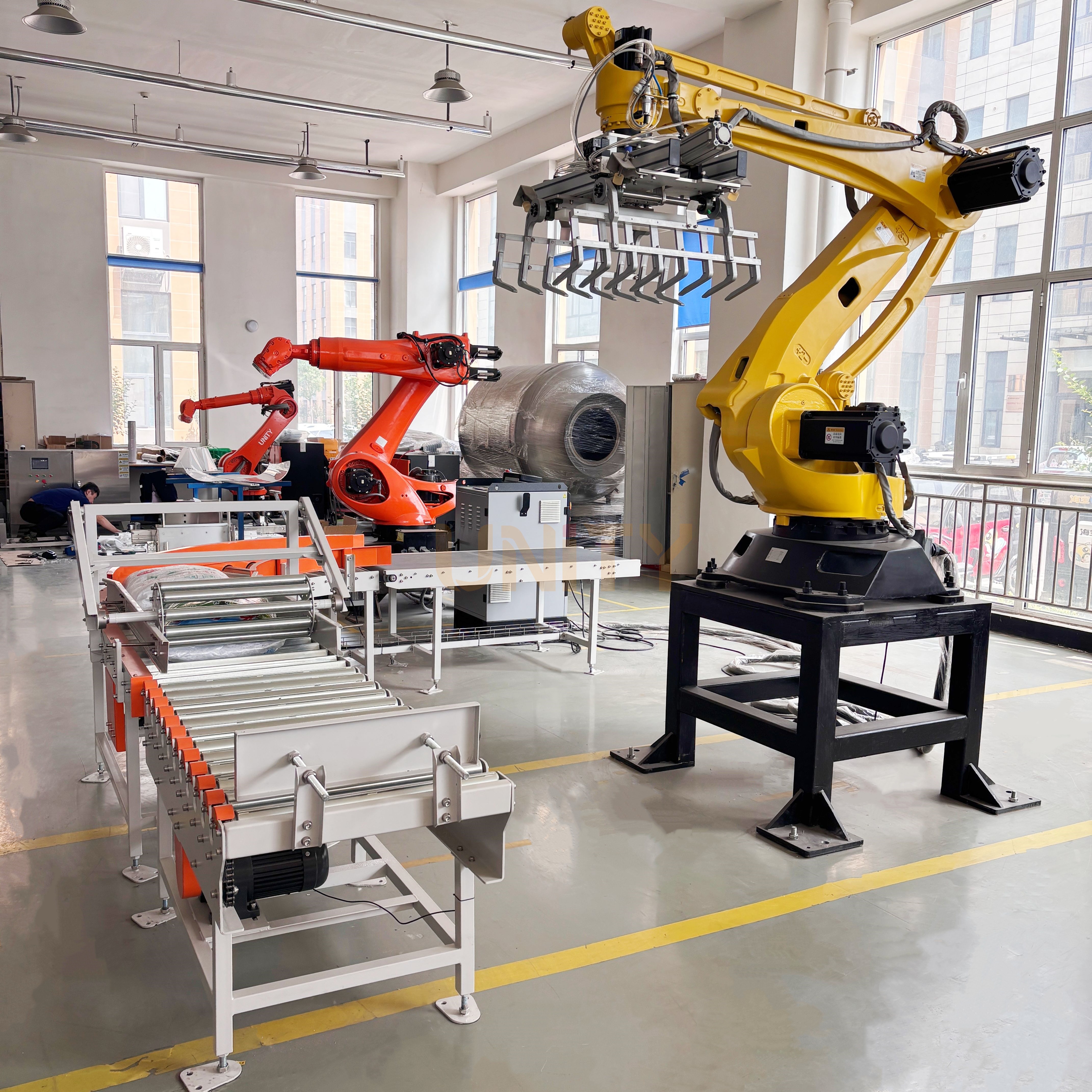
To make an informed decision, you must compare human effort against Robotic Palletizing across several key metrics. This breakdown highlights exactly where automation pulls ahead.
Human operators are strictly limited by their physical capacity. A typical worker maxes out at three to five picks per minute, and this rate degrades over an eight-hour shift. Scaling up for peak seasonal demand requires hiring temporary labor, which is increasingly difficult to find. Conversely, automation provides consistent, high-speed cycle times. Depending on the payload and EOAT, a robot easily executes 20 or more cycles per minute. It runs 24 hours a day with zero degradation in speed.
Manual processes rely heavily on unpredictable labor pools. Your throughput remains vulnerable to no-shows, sick days, and regional wage hikes. Automation shifts this dynamic. It does not strictly eliminate jobs. Instead, it reallocates human workers to higher-value, less hazardous roles. You can retrain your strongest team members for system supervision, quality control, or basic maintenance tasks.
Manual stacking accuracy varies wildly. Fatigue-induced errors result in leaning pallets. Automation offers exact placement repeatability. The machine executes complex, interlocking pallet patterns perfectly every time. This precision maximizes pallet density and ensures structural integrity for safe shipping. Retailers receive perfectly stacked loads, which improves your vendor compliance scores.
Evaluation Dimension | Manual Palletizing | Robotic Solution |
|---|---|---|
Speed & Consistency | Averages 3-5 picks/min; slows down over time. | 20+ picks/min; maintains exact speed 24/7. |
Scalability | Requires hiring/training more staff for peak seasons. | Handles surge capacity effortlessly without extra hires. |
Load Quality | Variable accuracy; prone to human error and instability. | Perfectly repeatable; builds complex, interlocking layers. |
Safety Risk | High risk of ergonomic injuries and strains. | Virtually eliminates end-of-line physical hazards. |
Securing budget approval requires a clear financial model. You must weigh the upfront costs against long-term savings. When you integrate an automatic palletizer, the financial benefits extend far beyond a simple headcount reduction.
The upfront capital expenditure (CapEx) includes hardware, software, shipping, and installation. This initial price tag can look intimidating. However, you must compare it against the ongoing operational expenditure (OpEx) of manual labor. Human OpEx includes hourly wages, overtime pay, healthcare benefits, and payroll taxes. Automation transforms variable daily labor costs into a fixed, predictable equipment asset.
The financial model improves drastically when you add working hours. Automation ROI accelerates exponentially with multi-shift operations. If you run one shift, it might take three years to break even. If you run two or three shifts, the machine replaces two or three different operators per day. In these multi-shift environments, facilities typically recover their investment in less than 24 months.
Direct labor wages only tell part of the story. You must factor in secondary financial benefits. Eliminating ergonomic hazards reduces costly workers' compensation claims and insurance premiums. Reducing turnover lowers human resources recruiting and onboarding expenses. Furthermore, precise handling decreases product shrinkage caused by dropped or crushed goods.
Equipment requires ongoing care. You should transparently budget for preventative maintenance, spare parts, and power consumption. Regular servicing prevents major breakdowns. Although you will spend money on grease, replacement sensors, and routine technician visits, these operating expenses remain much lower and more predictable than the costs associated with an unreliable manual workforce.
Automation solves many problems, but it is not a universal cure. Certain facility conditions make manual labor the more sensible choice. You must evaluate your operational limits before committing capital.
Industrial machinery requires a dedicated footprint. You need floor space for the arm's range of motion, infeed conveyors, safety interlocks, and perimeter fencing. Very tight or irregularly shaped facilities may simply lack the necessary room. If you cannot safely fit the safety barriers, a human worker remains your best option.
Robots thrive on repetition. If your facility handles hundreds of vastly different, non-standardized SKUs daily in very low volumes, automation struggles. Constant EOAT changes and recipe programming delays negate your efficiency gains. Manual laborers adapt instantly to different box sizes and weights without requiring new software instructions.
Automation introduces technical complexity. If your facility completely lacks maintenance personnel capable of troubleshooting basic robotic faults, you face a severe downtime risk. A simple sensor misalignment could stop production for hours while you wait for an external technician. Fortunately, modern remote diagnostics alleviate some of this burden, but you still need basic internal mechanical competence.
If you decide to proceed with automation, proper planning ensures a smooth installation. Skipping these foundational steps often leads to underperforming equipment and frustrating delays.
Never guess your numbers. Document your maximum payload weight, including the heaviest possible box or bag. Determine your required picks per minute during peak production, not just your daily average. Record your standard SKU dimensions accurately. The engineering team uses this exact data to size the robot arm and design the gripper.
Weigh every product variant.
Measure exact dimensions (length, width, height).
Calculate peak seasonal throughput requirements.
Your robot is only as fast as the lines feeding it. Ensure your upstream conveyors can deliver products fast enough to prevent starvation. If the robot constantly waits for boxes, you waste its potential. You may need to install accumulation conveyors to buffer the product and maintain a steady flow into the pick zone.
Select your integration partner carefully. Look for companies with proven experience handling your specific product type. Pliable bags behave very differently than rigid cardboard cases. Ask potential partners if they offer complete factory acceptance testing (FAT). You want to see the equipment run your actual product in their facility before it ever ships to your floor.
Manual palletizing is increasingly becoming a bottleneck and a liability in modern manufacturing. Human bodies simply cannot keep pace with high-speed production demands safely. The physiological toll leads to expensive turnover, product damage, and inconsistent output.
While the upfront investment in a robotic solution requires capital, the long-term stabilization of throughput, safety, and labor costs makes it the superior choice for scaling operations. By reallocating workers to safer tasks, you build a more resilient and efficient facility.
Take action today to secure your end-of-line processes. We encourage you to request a custom throughput analysis or site audit. By mapping your specific operational data, you can quickly determine your precise automation ROI timeline and take the first step toward a modernized production floor.
A: Modern Human-Machine Interfaces (HMIs) are highly intuitive. Basic operator training for recipe selection, pattern changes, and fault recovery typically takes just a few days. You do not need an advanced engineering degree to run these systems safely and effectively.
A: Some industrial robotic palletizing systems can be engineered to serve two or more production lines. Feasibility depends on the combined line throughput, product types, robot payload and reach, pallet locations, infeed arrangement, gripper design and required cycle time. In applications with high output or significantly different products, separate palletizing cells may be more practical.
A: Collaborative robots operate without safety fencing, saving significant floor space. They work well for low-throughput operations. However, traditional fenced robots offer much higher speeds and heavier payloads. If you need rapid cycles, a traditional unit usually remains the better choice.
A: Standard preventative tasks include greasing robot joints, inspecting pneumatic lines on the gripper, and checking safety sensors. Technicians usually perform these tasks on a 6-to-12-month schedule. Regular upkeep ensures long-term reliability and prevents unexpected downtime during peak production shifts.


