
- All
- Product Name
- Product Keyword
- Product Model
- Product Summary
- Product Description
- Multi Field Search
Views: 0 Author: Site Editor Publish Time: 2026-07-19 Origin: Site


Every end-of-line packaging operation faces a unique hurdle when alternating between pliable bags and rigid cartons. Switching between these contrasting materials frequently creates frustrating bottlenecks. Manual labor struggles to maintain consistent speeds under heavy loads. Legacy conventional layer palletizers lack the flexibility to handle shifting product shapes efficiently. You need a system capable of adapting instantly. This article provides a rigorous, vendor-neutral framework to help you evaluate, scope, and select a Robotic Palletizing Solution. We will guide you past inflated throughput claims and focus on practical engineering realities. You will learn how to assess gripper versatility, calculate true payload constraints, and ensure your facility meets essential safety standards. By understanding these technical nuances, you can confidently integrate automation. This approach genuinely enhances your daily throughput.
Success relies heavily on End-of-Arm Tooling (EOAT) versatility—handling shifting materials (bags) requires different gripper mechanics than rigid surfaces (cartons).
Payload capacity must account for the heaviest SKU (e.g., a 50kg palletizer setup) plus the weight of the tooling itself at maximum reach.
Evaluating footprint and safety compliance (fencing, light curtains) is as critical as the robot's raw speed.
Operations rarely upgrade their packaging lines without a compelling catalyst. You must identify specific operational thresholds first. Labor shortages remain a primary driver. Finding reliable workers for heavy lifting is increasingly difficult. Injury claims also provide a clear tipping point. Repetitive strain injuries plague manual stacking operations. They disrupt schedules and lower team morale. Throughput variability is another critical metric. Manual teams slow down during extended shifts. Conventional machines jam when encountering irregular shapes. Once your facility experiences these daily disruptions, manual methods become unsustainable. Upgrading becomes a strategic necessity rather than a luxury.
Modern manufacturing often requires high-mix, low-volume (HMLV) production schedules. Frequent changeovers between bags and cartons disrupt rigid conventional systems. Traditional layer palletizers excel at single-product continuous runs. However, they fail when product dimensions change several times a shift. Robotics become an absolute necessity here. A programmed robot adapts to new dimensions instantly. You simply select a new recipe in the software interface. The equipment adjusts its stacking patterns automatically. This flexibility handles HMLV operations seamlessly. It prevents hours of mechanical downtime during changeovers.
You must define strict Key Performance Indicators (KPIs) before speaking to vendors. Vagueness leads to poor system design. Define your operational needs using concrete numbers. Use the following baseline criteria to evaluate potential systems:
Target Picks Per Minute (PPM): Determine the exact speed required during peak production hours.
Required Uptime Percentage: Set a realistic availability goal, such as 98 percent continuous operation.
Maximum Changeover Time: Specify the allowable minutes to switch from a bag recipe to a carton recipe.
Error Rate Tolerance: Define the acceptable limit for dropped items or misaligned layers.
Clear KPIs keep integrators accountable. They ensure the proposed system matches your actual facility demands.
Bags present unique handling difficulties due to complex fluid dynamics. Their contents settle during transit along conveyors. Centers of gravity shift unpredictably. This shifting makes stable stacking very difficult. A dedicated bag palletizer requires specialized tooling mechanics. Side-clamping grippers are highly effective here. They secure the bag firmly from both sides. Good systems also incorporate bag-flattening conveyors upstream. Flatteners distribute the internal material evenly. This creates a uniform surface for stacking. Slip-sheet integration is another crucial requirement. Placing slip-sheets between layers prevents bags from sliding. It locks the pallet structure together safely.
Cartons demand a completely different approach. They maintain rigid shapes but feature delicate surfaces. A specialized carton palletizer typically utilizes vacuum grippers. Suction cups grab the top or side of the box securely. Fork-style effectors offer another reliable option for heavier cases. You must prioritize gentle handling. Aggressive movements damage cardboard corners. They also cause tape-seal failures. If a vacuum gripper releases too late, it rips the packaging. Precision control is vital. The machine must place cartons squarely to build a perfectly plumb pallet.
Some operations need to handle both formats continuously. Hybrid End-of-Arm Tooling (EOAT) attempts to solve this problem. These tools combine vacuum cups and mechanical clamps into one unit. They process both formats without requiring physical tool changes. However, you must maintain a skeptical view of hybrid solutions. They introduce distinct trade-offs. Combining mechanisms makes the tool significantly heavier. This extra mass reduces the available payload capacity for the actual product. It also forces the robot to move slower. You must carefully weigh the convenience of hybrid tools against these performance penalties.
Tooling Characteristics Comparison
Feature | Bag Gripper | Carton Gripper | Hybrid Gripper |
|---|---|---|---|
Primary Mechanism | Side-clamping fingers | Vacuum suction or forks | Combined clamp and vacuum |
Handling Challenge | Shifting center of gravity | Tape-seal failure | Excessive tooling weight |
Speed Impact | Moderate (requires alignment) | High (fast pick and place) | Slower (due to mass) |
Upstream Needs | Bag flattener conveyors | Metering belts | Complex dual infeeds |
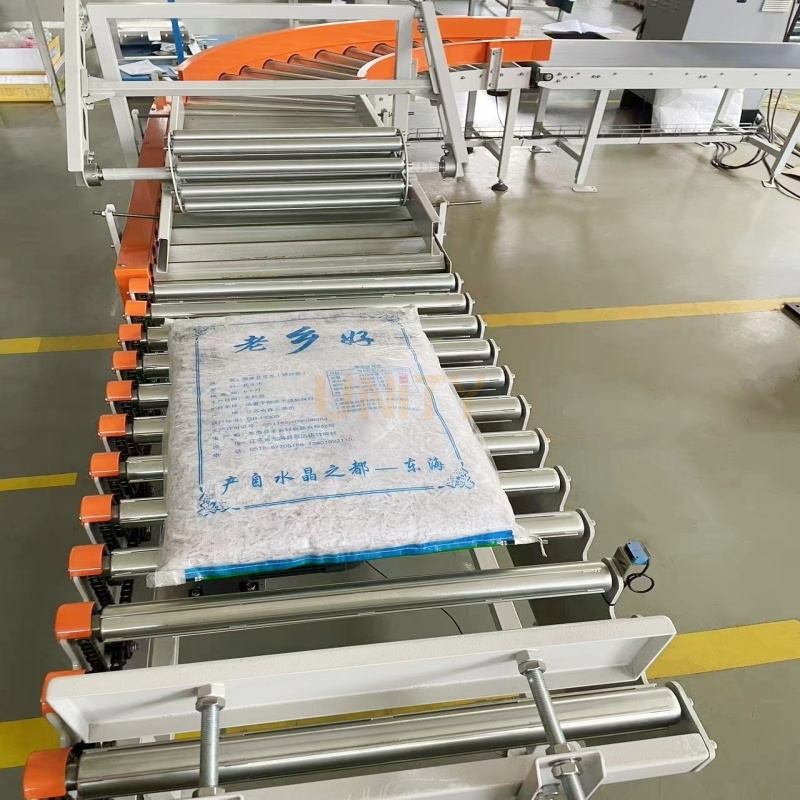
Many buyers misunderstand payload specifications entirely. Undersizing the equipment is a remarkably common mistake. You cannot size a machine based solely on product weight. A true 50kg palletizer must lift the 50kg product plus the tooling itself. Specialized EOAT often weighs between 15 and 25 kilograms. Therefore, lifting a 50kg bag actually requires a robot rated for 75kg or more. If you ignore tooling weight, the motors will burn out prematurely. The system will trigger constant overload faults. Always calculate the maximum combined mass before selecting your hardware.
Reach extends far beyond a simple straight line. The robot arm must comfortably access the highest pallet tier. It must reach the furthest corner of the pallet footprint. You must also evaluate kinematic lock, known as singularity. Singularity occurs when robot joints align perfectly. The arm temporarily loses a degree of freedom. It becomes stuck or moves unpredictably. A properly sized system maintains slightly bent joints even at maximum reach. This preserves fluid motion. It ensures stability when placing heavy objects on the top layer.
Manufacturers often advertise spectacular laboratory-condition speeds. You must heavily discount these claims. Real-world environments rarely match pristine testing facilities. Several variables slow down actual cycle times:
Product settling times require slight delays before gripping.
Complex interlocking stacking patterns demand rotational maneuvers.
Slip-sheet insertion consumes valuable seconds during the cycle.
Safety sensor resets add minor delays after human intervention.
Guide your integrator to provide a realistic simulation. Provide your specific box and bag dimensions. Request a digital twin test using your exact stacking recipes. This verifies true cycle times before you sign a contract.
Floor space is a premium asset in any facility. You must evaluate the total cell footprint accurately. Do not just measure the base of the robot. You must account for auxiliary equipment. The cell requires pallet dispensers. It needs slip-sheet racks. Infeed and outfeed conveyors consume significant space. Maintenance personnel also need safe walking paths around the perimeter. Use precise CAD software to map the spatial layout. Ensure forklifts have adequate turning radii when retrieving finished pallets. Poor spatial planning leads to operational bottlenecks later.
Industrial automation requires strict safety architecture. You must implement comprehensive risk mitigation strategies. Compliance with OSHA and RIA standards is mandatory. Physical fencing forms the primary defense perimeter. It keeps personnel away from moving machinery. Safety interlocks on access doors immediately halt operations if opened. Light curtains protect the outfeed zones. They detect forklifts entering the area and pause the machine safely. Area scanners monitor blind spots dynamically. Never compromise on these safety features. They protect your workforce and prevent disastrous accidents.
The industry currently debates using collaborative robots (cobots) for heavy tasks. Some vendors suggest cobots replace heavy-duty industrial systems. You should briefly dismiss this myth for end-of-line palletizing. Cobots excel at lightweight, slow-moving tasks near humans. High-payload, high-speed bag and carton handling demands industrial strength. A cobot cannot maneuver 50kg bags at high speeds safely. The physical physics prevent it. Heavy-duty industrial setups remain the only reliable choice for demanding end-of-line applications.
Hardware represents only half the solution. Control software dictates daily performance. You must evaluate WMS and ERP connectivity carefully. The control system needs to receive SKU data seamlessly. It must dynamically adjust stacking patterns based on production schedules. Palletizing software simplicity is crucial. Operators should not need programming degrees to change recipes. A visual drag-and-drop interface works best. It allows floor managers to create new box patterns quickly. Good software predicts collisions. It optimizes path planning automatically to save cycle time.
Implementation timelines often slip due to poor planning. You must outline a realistic rollout roadmap. The Factory Acceptance Testing (FAT) occurs at the vendor site. You review the fully assembled machine running your actual product. Never skip the FAT. It catches engineering flaws before shipping. The Site Acceptance Testing (SAT) happens on your floor. SAT proves the machine integrates with your existing conveyors. Expect the entire process to take several months. Rushing the FAT or SAT guarantees integration failures later.
Installing a new cell disrupts current production. You must manage this deployment downtime proactively. Provide strategies for parallel integration. Build the new robotic cell adjacent to the running line if space permits. Divert product only when the new cell is fully commissioned. If space is tight, schedule the installation over a long holiday weekend. Pre-wire electrical drops and pneumatic lines beforehand. Good preparation prevents shutting down the packaging line unnecessarily. It protects your weekly shipping quotas during the upgrade.
Choosing the right integration partner dictates your success. You must ask critical, probing questions during the vetting phase. Do not accept generic sales brochures. Ask integrators directly: "Do you have case studies specifically alternating between heavy bags and cartons?" Request references from similar industries. Evaluate their engineering team's depth. Do they outsource the gripper design? You want a vendor who controls the critical engineering elements in-house. Strong vendors welcome deep technical scrutiny.
Never buy a system based solely on digital animations. You must insist on physical testing. Send your most difficult-to-handle SKUs to the vendor. Include half-empty bags. Send loosely packed or bulging cartons. Force them to prove their gripper designs handle worst-case scenarios. Request a video-documented Proof of Concept (PoC). The video must show the machine running continuously without dropping items. A successful physical PoC eliminates technical anxiety. It proves the proposed solution actually works.
Post-installation support separates excellent vendors from average ones. Evaluate their Service Level Agreements (SLAs) closely. Emphasize the importance of local spare parts availability. Specialized EOAT components and large servomotors often have long lead times. If a custom vacuum manifold breaks, you cannot wait weeks for overseas shipping. Demand guaranteed response times for technical support. Remote troubleshooting capabilities are essential. The vendor should log into the system securely to diagnose software faults instantly.
Choosing the right end-of-line automation requires looking beyond flashy speed metrics. Success depends heavily on precise EOAT engineering. You must account for shifting bags and rigid cartons using appropriate gripper technologies. Realistic payload calculations prevent premature hardware failures. Thoughtful footprint mapping and strict safety compliance ensure a secure working environment. Ultimately, solving this bottleneck is less about buying the fastest machine and more about smart system architecture.
Take action today to modernize your packaging line. Schedule a comprehensive site audit with a qualified integrator. Gather your most difficult SKUs. Request a custom 3D simulation of your specific bag and carton layouts. Proper preparation now guarantees a seamless integration tomorrow.
A: In some applications, one robotic palletizing system can be configured to handle both bags and cartons using a hybrid gripper or an automatic tool-changing system. However, feasibility depends on the product dimensions, weight, packaging stability, required throughput, infeed layout, robot payload and reach. A technical assessment and product-handling test are recommended before confirming the final configuration.
A: The necessary space varies heavily based on your specific layout. Typical industrial setups usually require at least 150 to 250 square feet. This measurement factors in mandatory safety fencing, pallet dispensers, slip-sheet racks, and adequate staging areas for forklifts to maneuver safely.
A: Most facilities see a complete return on investment within 18 to 36 months. The exact timeline depends heavily on local labor rates and your shift volume. Facilities running two-shift or three-shift operations achieve ROI much faster. Significant reductions in workers' compensation claims also accelerate the financial return.


