
- All
- Product Name
- Product Keyword
- Product Model
- Product Summary
- Product Description
- Multi Field Search
Views: 0 Author: Site Editor Publish Time: 2026-07-31 Origin: Site


Manual material handling remains one of the most physically demanding areas in modern manufacturing. Expecting humans to repeatedly lift loads weighing 110 pounds severely threatens operational efficiency while driving up injury rates. Handling 50kg payloads manually introduces critical ergonomic risks to your workforce. It limits your overall line throughput and worsens severe labor shortage challenges across heavy packaging sectors. Facilities simply cannot maintain peak productivity when relying heavily on exhaustible manual labor.
Transitioning to an automated framework shifts these end-of-line operations from a constant physical bottleneck into a highly predictable, continuous process. This guide gives operational leaders an objective framework for evaluating heavy-payload robotic automation. You will discover practical return-on-investment calculations, integration strategies, and proven methodologies to optimize your packaging line. By understanding the core technical requirements, you can eliminate high-turnover roles and secure a more resilient manufacturing environment.
Deploying a 50kg robotic palletizer eliminates critical workplace injury risks while stabilizing daily throughput.
Evaluating a heavy load palletizer requires factoring in End-of-Arm Tooling (EOAT) weight; a 50kg payload often demands a robot rated for 70kg+.
True ROI calculations must include offset costs from reduced worker's compensation, lowered turnover, and increased stack stability, not just direct labor replacement.
Successful implementation relies on precise integration between the end-of-line robot, existing conveyors, and facility safety infrastructure.
Repetitive lifting of 50kg units far exceeds recommended ergonomic safety limits. Most occupational health organizations advise against human workers manually lifting anything over 23kg (50 lbs) continuously. Forcing operators to lift 50kg (110 lb) bags or cartons drastically increases the likelihood of musculoskeletal disorders. These injuries lead to high OSHA incident rates, expensive compensation claims, and severe worker fatigue. As operators fatigue, they lose form, increasing the risk of acute spinal injuries. Automating this process removes humans from the primary danger zone entirely.
Manual stacking speeds degrade significantly over the course of a standard shift. An operator might start the morning moving fast, but their output naturally slows down by the fourth or fifth hour. This throughput volatility makes it impossible to plan downstream logistics accurately. Installing an automatic palletizer solves this inconsistency immediately. Automation maintains a constant cycle time from hour one to hour twenty-four. You gain total predictability over your daily production output.
Plant managers face extreme difficulty in recruiting and retaining workers for physically punishing end-of-line tasks. Younger generations of workers actively avoid roles requiring heavy, repetitive lifting. This labor scarcity leads to understaffed shifts, forced overtime, and eventually, high employee turnover. Training new employees constantly drains resources and slows down production. Replacing this miserable task with automation allows you to upskill your workers and reassign them to roles requiring critical thinking rather than brute force.
Robotic arms do not need breaks, shift changes, or rest periods. They achieve reliable picks-per-minute (PPM) regardless of shift duration or load weight. If your production line outputs ten bags per minute, the robot will precisely match that pace all day. This consistency allows facility managers to synchronize upstream processing equipment perfectly. You eliminate bottlenecks at the loading dock because pallets always finish right on schedule.
Human stackers often misalign heavy bags as they tire, leading to leaning pallets. Programmable stack patterns ensure optimal weight distribution across the entire pallet. The robot places every single item squarely in its designated position. This precision reduces product damage during transit. It proves especially critical for heavy, shifting materials like powders, aggregates, or animal feed. Perfectly squared pallets wrap tighter and stack safer in warehouse racks.
Modern automated systems handle much more than just a single product type. With the right interchangeable tooling, a single system can operate as a 50kg bag palletizer during the morning shift, then switch to handling heavy cartons, drums, or buckets in the afternoon. Quick-change EOAT systems allow operators to swap grippers in minutes. You do not need entirely separate production lines for different packaging formats.
Facility floor space always remains at a premium. Legacy conventional layer palletizers consume massive amounts of square footage due to their complex conveyor matrices and elevator mechanisms. Modern robotic arms often require significantly less floor space. A well-designed robot cell condenses the staging, picking, and wrapping zones into a tight, highly efficient footprint.
Manual vs. Automated Palletizing Performance Comparison
Operational Metric | Manual Stacking | Robotic Automation |
|---|---|---|
Cycle Consistency | High volatility over 8 hours | 100% consistent pacing |
Ergonomic Risk | Severe (110 lb payload) | Zero risk to operators |
Stack Stability | Inconsistent, prone to leaning | Mathematically precise placement |
Turnover Rate | Very high | N/A (Repurposed labor) |
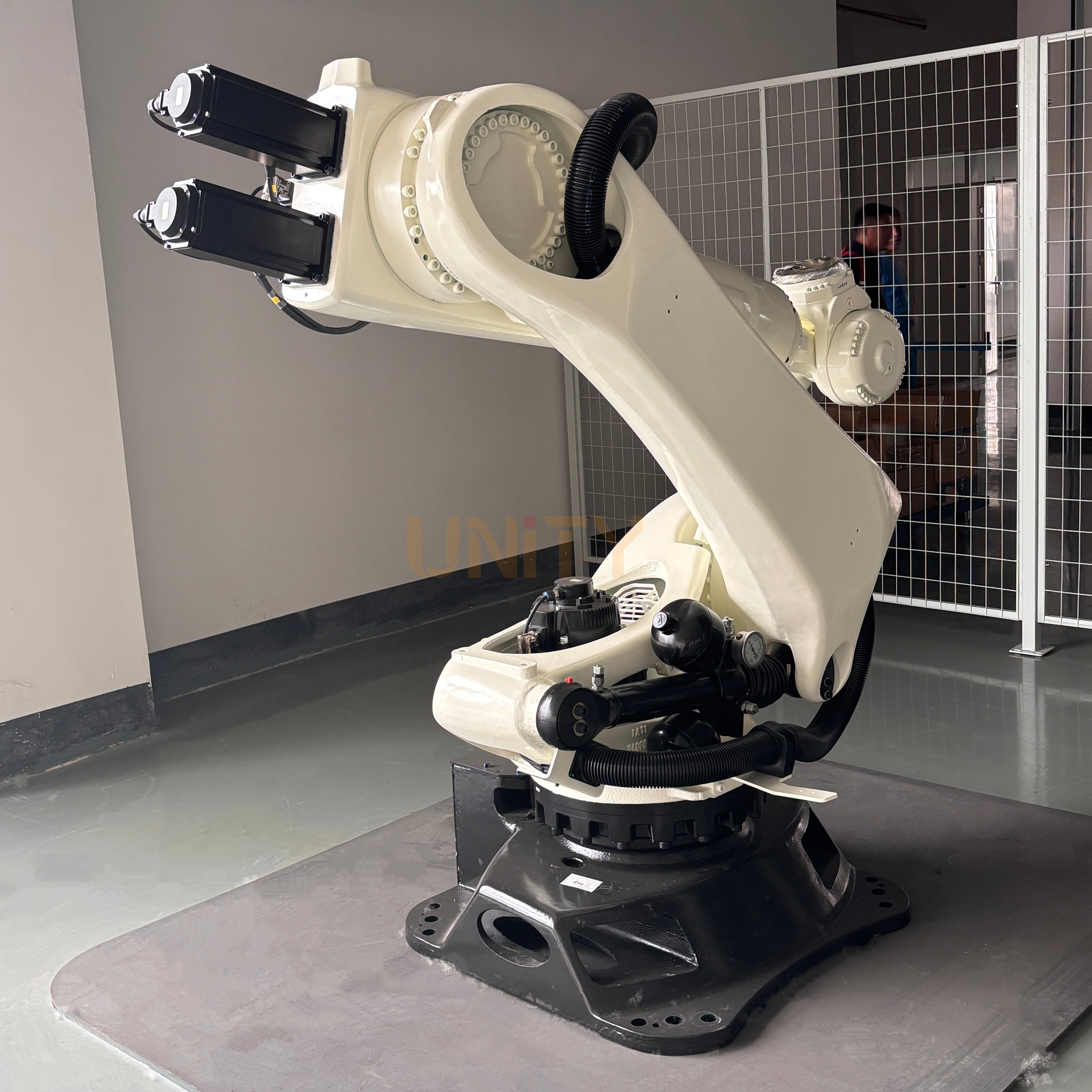
When selecting automation equipment, facilities usually choose between traditional industrial arms and collaborative robots (cobots). High-payload cobots offer easier programming interfaces and potentially operate without safety fences if running at reduced speeds. However, they historically face strict limitations at the 50kg threshold. While newer cobot models attempt to breach this barrier, they often sacrifice reach and speed. Traditional industrial robots offer proven durability for heavy, continuous loads. They achieve much faster cycle times and easily handle the demands of shifting payloads. Because of their raw power, an industrial end-of-line robot requires rigid safety fencing and physical light curtains to protect human workers.
One of the most common mistakes in robotics is ignoring the weight of the tooling. Lifting a 50kg bag requires a robot with a payload capacity significantly higher than 50kg. You must account for the mass of the pneumatic or mechanical grippers themselves. A heavy-duty clam-shell gripper designed for 50kg aggregates might weigh 25kg on its own. Therefore, properly sizing your 50kg Robotic Palletizer means selecting an arm rated for at least 75kg to 80kg. Pushing a robot exactly to its maximum payload limit drastically reduces its lifespan and slows down its acceleration.
Many plant managers wonder if they need expensive 3D vision cameras. Evaluating the necessity of 3D vision depends entirely on your specific application. If you use the robot for depalletizing mixed loads or picking highly irregular bags from a bin, 3D vision proves essential. However, standard blind-stacking software works perfectly for most end-of-line applications. If your upstream conveyors consistently deliver the product to a fixed picking point, the robot can rely on simple sensors and encoder counts. Sticking to standard software keeps integration simple and reduces potential failure points.
The most immediate financial justification comes from labor reallocation. Moving 50kg units typically requires at least two manual operators per shift just to manage the physical strain. Over a three-shift operation, that equates to six full-time salaries, plus benefits and overtime. Automating this zone allows you to reallocate these operators to higher-value, less hazardous facility roles. You instantly eliminate the direct wages tied to this specific bottleneck.
True ROI stretches far beyond simple wages. You will see measurable drops in workers' compensation claims related to back injuries and joint strain. Hiring costs plummet because you no longer need to constantly recruit replacements for burned-out stackers. Furthermore, training downtime disappears. When an operator quits, you lose weeks of productivity training a replacement. A robot retains its programming perfectly, eliminating knowledge drain.
Implementing automation drastically improves your OEE scores. You must track uptime, performance efficiency, and quality rate improvements after installing a heavy load palletizer. Uptime increases because robots do not take unplanned breaks. Performance efficiency stabilizes because the system hits its target picks-per-minute reliably. Quality rates improve because precise stacking prevents crushed boxes and burst bags. Tracking these three metrics provides undeniable proof of the automation's value.
The palletizer is only as fast as your infeed conveyor. You cannot view the robot as an isolated magic box. Inconsistent bag pacing or varied product orientation causes severe fault errors. If bags arrive skewed or bunched together, the robot gripper will fail to establish a secure hold. You must ensure your upstream belts deliver products uniformly. Implementing pacing conveyors and zero-pressure accumulation zones prevents jams before the product ever reaches the robot cell.
Handling heavy bags requires specific preparation. Bags filled with powders or aggregates tend to settle unevenly during transit down a conveyor line. You must condition them before they reach the picking station. Proper conditioning ensures safe gripping and stable stacking. Follow these sequential steps for optimal bag presentation:
Align the bag squarely on the center of the belt using side guide rails.
Pass the product through a bag flattener conveyor to distribute the internal contents evenly.
Drive the bag into a fixed staging stop to provide the robot with an exact, repeatable picking coordinate.
Skipping these conditioning steps guarantees dropped bags and leaning pallets.
Industrial automation demands strict adherence to safety standards. Acknowledging the strict space requirements early prevents installation delays. You must account for heavy-duty industrial safety fencing, safety laser scanners, and physical light curtains. Furthermore, you need adequate pallet staging zones. The robot needs a place to pick empty pallets and drop full ones safely. Forklift drivers need clear, protected pathways to remove finished loads without entering the robot's active working radius.
Modern factories rely on data. Tying your palletizing software into facility-wide inventory tracking presents both challenges and massive benefits. A seamless integration allows the robot to signal your Warehouse Management System (WMS) the exact moment a pallet completes. The system automatically generates shipping labels and updates your Enterprise Resource Planning (ERP) software in real time. This integration eliminates manual barcode scanning and prevents inventory discrepancies between the factory floor and the shipping dock.
Embrace Comprehensive ROI: Look beyond hourly wages. Factor in the elimination of heavy-lifting injuries, reduced turnover, and the financial benefits of perfectly stable pallets.
Size the Hardware Correctly: Always account for the weight of your end-of-arm tooling. A 50kg payload fundamentally requires a robot rated for much heavier capacities to maintain speed and longevity.
Prioritize Bag Conditioning: Invest in upstream flatteners and pacing conveyors. A robot can only place a product perfectly if the product arrives perfectly.
Shortlisting Logic: Base your vendor selection not just on the base robot cost. Evaluate the integrator’s specific experience handling your exact 50kg product types, distinguishing between shifting aggregates and rigid blocks.
Next-Step Action: Request a Proof of Concept (PoC) or Factory Acceptance Test (FAT). Use your actual product and pallets to verify cycle times and stack stability before final sign-off.
A: No. Modern interfaces allow regular line operators to select pre-programmed recipes via simple touchscreens. Specialized programming is only required during the initial commissioning or when introducing entirely new SKUs and complex stack patterns to the system.
A: They manage shifting materials through specialized clam-shell or finger grippers (EOAT) designed to secure non-rigid loads from underneath and the sides. This tooling is always paired with upstream bag flatteners to ensure the bag presents a uniform shape before gripping.
A: Depending on the level of customization, tooling requirements, and the current integrator backlog, facilities typically expect 16 to 32 weeks from the final purchase order to complete on-site commissioning.


