
- All
- Product Name
- Product Keyword
- Product Model
- Product Summary
- Product Description
- Multi Field Search
Views: 0 Author: Site Editor Publish Time: 2026-06-01 Origin: Site


Manual strawberry decapping poses a massive bottleneck for modern processing plant managers. It demands intense physical labor. It introduces unnecessary hygiene risks. It frequently causes inconsistent fruit yield across shifts. Fortunately, food processing automation is rapidly advancing to solve these exact issues. The industry shift toward fully automatic de-calyx systems relies heavily on new breakthroughs in machine vision and delicate robotic handling. Facilities can now process tons of soft fruit daily without degrading quality. This guide provides a realistic, engineering-focused evaluation framework for your facility. You will learn how to select and integrate a commercial-grade strawberry calyx remover into your existing production line seamlessly. We aim to help you maximize yield, optimize throughput, and streamline operations effectively from start to finish.
Fully automatic strawberry calyx removers shift production from labor-dependent bottlenecks to predictable, high-throughput operations.
Machine vision integration is the differentiator between legacy "blind cut" systems (high waste) and modern precision decapping (maximum yield).
Evaluating a system requires looking beyond theoretical speed to calculate actual yield retention and IP-rated washdown compliance.
Standalone machines deliver limited ROI without upstream singulation and downstream automated packaging integration.
Processors consistently struggle to find reliable seasonal workers. Manual de-calyxing carries significant hidden costs. Human labor leads to physical fatigue. Fatigue inevitably destroys cutting precision. When workers get tired, they slice off too much healthy fruit. They also slow down during long shifts. This creates uneven throughput. Automation resolves these labor ceilings. It ensures steady, uninterrupted production lines regardless of seasonal labor shortages.
Many plant managers obsess over raw mechanical speed. They count berries per minute. We consider this a vanity metric. Fast machines often chop indiscriminately. They remove excess healthy fruit alongside the green top. True success requires a precise balance. You need high speed. You also need minimal flesh loss.
Yield retention drives profitability: Saving an extra three millimeters of flesh per berry transforms profit margins.
Speed without accuracy wastes money: A machine processing 500 berries per minute is useless if it discards 15% of usable flesh.
Consistency maximizes volume: Automated systems perform the exact same cut at hour one and hour ten.
Human touchpoints naturally increase cross-contamination risks. Automation removes human hands from the direct product zone. This operational shift helps facilities meet stringent food safety protocols. Compliance bodies like the USDA and FDA look favorably upon reduced human contact. You minimize bacterial exposure. You elevate overall food safety.
Not all automation delivers the same results. You must understand the underlying technology powering the machine. Processors generally choose between two distinct categories. They select either mechanical cutters or vision-guided robotic systems.
Mechanical systems rely on physical constraints. They use sizing plates or physical rollers to position the fruit. A static blade then cuts the top off the strawberry. These machines offer a lower initial capital cost. However, they possess a severe limitation. They struggle immensely when handling high variance in fruit caliber. Strawberries naturally vary in size and shape. Mechanical systems treat every berry identically. This rigid approach often results in 10-15% usable flesh waste.
Modern processors heavily favor vision-guided technology. These systems utilize 3D imaging or advanced optical sensors. The sensors identify the exact calyx position on each individual berry. They map the geometry in milliseconds. The software then guides dynamic blades or robotic end-effectors to execute the perfect cut. This method drastically reduces waste. It easily handles variable fruit sizes without requiring mechanical pre-sorting.
We must add a skeptical note regarding vision systems. They are highly intelligent but not magic. Vision systems require proper upstream singulation to function accurately. You must separate overlapping berries before they reach the camera zone. Clustered fruit confuses the optical sensors.
Technology Comparison Chart: Mechanical vs. Vision-Guided Systems | ||
Feature / Metric | Mechanical & Sizing-Based | Vision-Guided & Robotic |
|---|---|---|
Mechanism | Physical rollers and static blades | 3D optical sensors and dynamic blades |
Size Variance Handling | Poor (requires rigid pre-sorting) | Excellent (adapts per individual berry) |
Average Flesh Waste | 10% - 15% | Under 5% |
Singulation Requirement | Low to Moderate | Strictly Required |
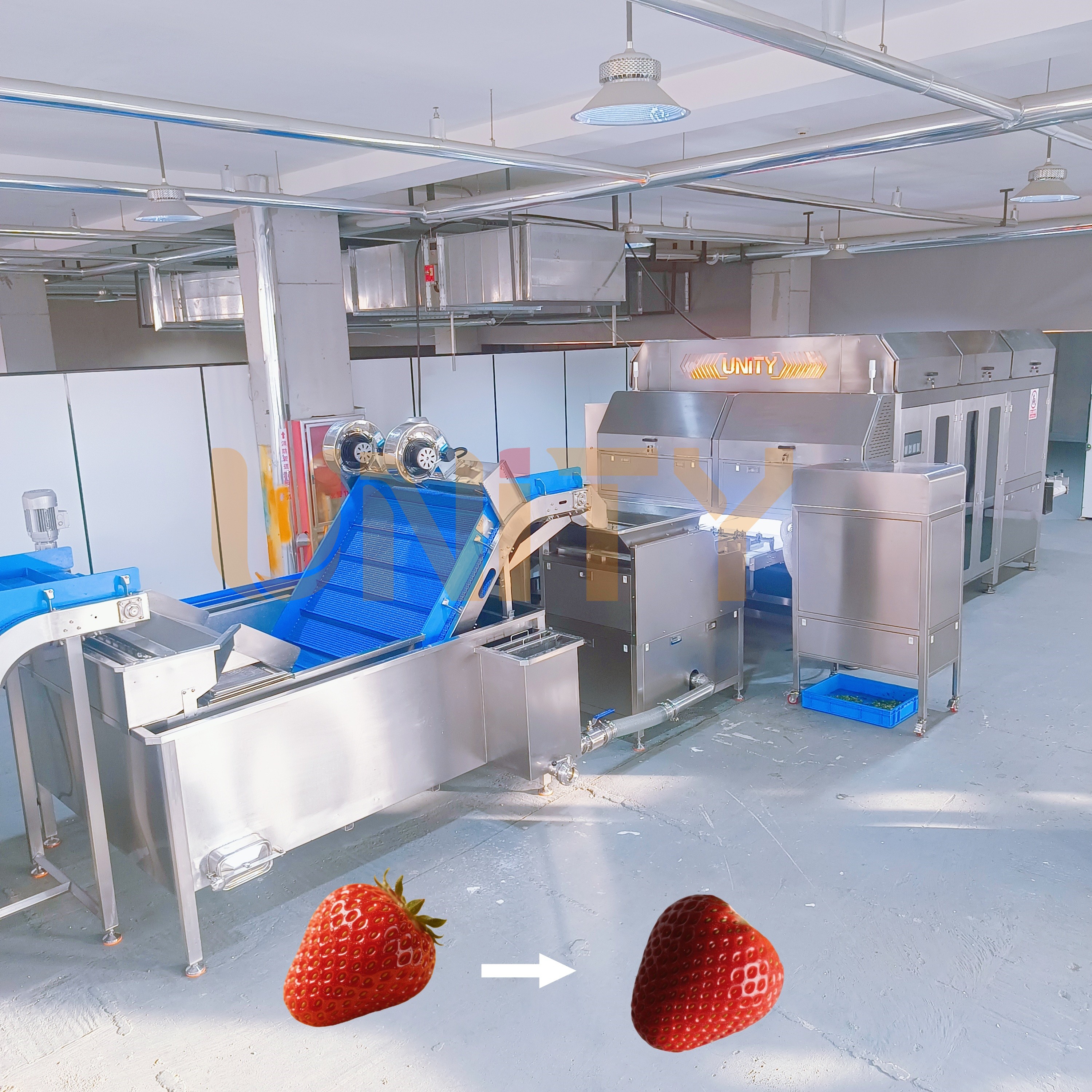
Choosing the right equipment demands a structured evaluation framework. You cannot buy industrial machinery based on a brochure alone. Plant managers must scrutinize the hardware under real-world operating conditions.
Throughput Capacity & Scalability: You must match the machine capacity (measured in kg/hr) to your peak harvest season volume. Do not under-size your equipment. Evaluate if the system is modular. Can you easily add lanes as customer demand grows?
Hygiene and Washdown Standards: Look strictly for 304 or 316 stainless steel construction. Inspect the frame for sloped drainage surfaces to prevent water pooling. Electronics must carry an IP69K rating. The hygiene standards should rival those of high-contamination environments, such as a sausage production line, to ensure rapid, safe CIP (Clean-in-Place) execution.
Maintenance & Blade Lifespan: Assess the ease of replacing cutting mechanisms. Sharp blades ensure clean cuts. Dull blades bruise the fruit. Downtime for blade swapping directly impacts OEE (Overall Equipment Effectiveness). Ask the vendor how many minutes it takes to change the entire blade set.
Software & Reject Handling: Software intelligence separates average machines from exceptional ones. Does the system offer data logging for yield tracking? You need dashboard visibility. Furthermore, observe how the machine physically diverts un-decapped or defective fruit. It must segregate bad products cleanly from the primary flow.
A standalone machine operates in isolation. Your processing plant does not. You must integrate the new equipment smoothly into existing workflows. Bottlenecks often migrate when you automate a single process.
The de-calyx machine expects a perfect presentation of fruit. We emphasize the need for reliable bulk feeding. You need robust washing stations. You also need precise singulation conveyors. These upstream prerequisites ensure the machine receives fruit at an optimal, steady rate. Surges or gaps in the fruit feed ruin efficiency. Vision cameras cannot scan overlapping clusters.
Removing the decapping bottleneck floods your downstream stations. You must upgrade end-of-line systems to handle the abruptly increased output. Manual boxing stations will quickly fail under the new volume. Your downstream conveyors must carry away the clean berries as fast as the machine processes them.
Consider mapping the entire post-processing flow. The berries exit the cutting chamber. They move into IQF (Individual Quick Freezing) tunnels or pureeing vats. Next, they enter bulk packaging. Facilities typically handle this by moving into bulk packaging using a bag inserting machine. The line continues, followed by a case erector machine for rapid boxing. Ultimately, the sealed boxes reach a palletizing robot for cold-storage readiness. Fully connecting these stages guarantees maximum factory throughput.
Integrating new technology always introduces friction. You must anticipate implementation realities before signing the purchase order. Preparation prevents expensive installation delays.
Address the physical space required on your factory floor. You cannot only measure the machine itself. You must allocate footprint for the necessary infeed and outfeed conveyors. Maintenance personnel require access space to open panels and swap parts safely. Tight layouts frustrate mechanics and delay repairs.
Strawberries are agricultural products. They change. Different strawberry varieties require different software recipes. Conical berries behave differently than round ones. Factory Acceptance Testing (FAT) must use your plant's actual fruit supply. Do not accept a successful test using perfectly uniform greenhouse fruit. Demand proof using your specific, irregular cultivars.
Automation changes your workforce requirements. It highlights the transition from managing manual labor to requiring technically skilled operators. Your team no longer cuts fruit by hand. They now troubleshoot HMI (Human-Machine Interface) panels. They calibrate optical sensors. They manage software recipes. You must invest in vendor-led training programs. A sophisticated machine fails if operators refuse to learn its interface.
Investing in a fully automatic strawberry calyx remover is fundamentally a yield-preservation and risk-mitigation strategy. It frees your plant from unpredictable manual labor constraints. It radically improves hygiene standards. It ensures you capture every possible gram of usable fruit flesh.
We strongly advise decision-makers to prioritize vendors who offer vision-guided precision. Look for partners providing transparent yield data and robust integration support. Do not simply choose the vendor competing solely on the lowest initial price. Cheap mechanical systems often cost more over time due to flesh waste and high maintenance.
Take actionable next steps today. Recommend scheduling a localized material test with a trusted vendor. Ship them your specific berry cultivars. Use the test results to calculate exact yield improvements. This empirical data will help you formalize your financial timelines and secure internal project approval.
A: The typical payback period ranges between 12 and 24 months. You calculate this based on your daily shift volume, local labor rates, and the immediate reduction in usable flesh waste. High-volume facilities running dual shifts often see returns much faster than smaller seasonal operations.
A: Most modern systems manage irregular shapes well using 3D vision. However, overly soft or overripe fruit poses a challenge. Mushy berries may jam mechanical grippers or break apart during the cutting stroke. You must maintain minimum fruit firmness requirements for optimal performance.
A: Vision-based robotic systems adapt dynamically to each berry. They do not require strict pre-sorting by size. Conversely, older mechanical systems strictly require pre-graded fruit to prevent massive yield loss. Upgrading to vision eliminates the grading bottleneck.
A: Maintenance intervals depend heavily on daily tonnage and blade material. High-grade stainless steel blades typically require replacement or sharpening every few weeks during peak continuous operation. Your maintenance team should inspect blade edges daily to ensure clean cuts.


