
- All
- Product Name
- Product Keyword
- Product Model
- Product Summary
- Product Description
- Multi Field Search
Views: 0 Author: Site Editor Publish Time: 2026-06-05 Origin: Site


End-of-line packaging is undergoing a profound structural transformation globally. High-mix, low-volume production runs now dominate modern manufacturing floors. They mercilessly expose the rigid limitations of traditional mechanical case erectors. Manufacturers need adaptable automation to survive these demanding supply chain pressures. Enter the modern robotic case erector machine. We define it as a highly flexible, multi-functional cell. It seamlessly picks, forms, packs, and seals boxes directly without demanding tedious manual mechanical changeovers.
This article provides a comprehensive technical evaluation framework. You will learn how to confidently shortlist the right robotic erectors for your specific facility. We will explore how to integrate these dynamic cells into existing lines efficiently. Finally, you will discover actionable engineering strategies to mitigate common deployment risks.
Flexibility Over Raw Speed: Robotic erectors excel in multi-SKU environments through adaptive End-of-Arm Tooling (EOAT), enabling zero-downtime changeovers.
Footprint Efficiency: Combined erector-packer cells drastically reduce the floor space required compared to sequential traditional machines.
The Corrugate Variable: Over 60% of automation failures in case erecting stem from untested corrugate quality and hidden seam interference; physical sample testing is mandatory before procurement.
Holistic Integration: Maximum ROI is achieved when the case erector machine seamlessly handshakes with upstream processing and downstream tertiary equipment.
The business problem driving automation upgrades is incredibly straightforward. Traditional packaging machines rely heavily on dedicated hard tooling. They demand extensive manual changeovers whenever operators switch box sizes. These switch-overs often take more than fifteen minutes. This excessive downtime murders overall equipment effectiveness (OEE). Furthermore, sequential mechanical systems consume massive factory footprints.
The robotic alternative elegantly solves these spatial and operational constraints. We typically categorize these robotic systems into two primary classes.
First, we have collaborative robots (Cobots). These units fit perfectly in exceptionally tight spaces. They operate safely alongside human workers without requiring physical safety fencing. You can program them via intuitive touch-screen interfaces. They suit lower-speed, high-mix environments perfectly. Operators can adjust parameters without writing a single line of complex code.
Second, we utilize industrial 6-axis robots. You absolutely need these heavy-duty systems for demanding workloads. They handle high-payload, high-speed requirements effortlessly. Plants rely on them for heavy pharmaceutical tracking or dense consumer goods packing. They deliver uncompromising speed and absolute precision.
How do you measure success when choosing between these options? You must base your final decision on a few core operational metrics. Evaluate your daily changeover frequency meticulously. Measure your available floor space down to the inch. Determine your strict cycles per minute (CPM) requirements. Finally, decide if you genuinely need random case erecting capabilities. Random erecting allows the cell to handle mixed dimensions simultaneously without stopping.
Feature/Metric | Traditional Mechanical Erector | Cobot Case Erector | Industrial 6-Axis Erector |
|---|---|---|---|
Changeover Time | > 15 minutes (Manual tools) | < 1 minute (Touch-screen) | Instant (Adaptive EOAT) |
Footprint | Large (Sequential stations) | Ultra-compact (No fencing) | Moderate (Safety guarding needed) |
Speed (CPM) | Extremely High (Single SKU) | Low to Moderate | High |
Random Erecting | Impossible | Possible (Speed limited) | Highly Effective |
You need a highly structured lens to compare OEM spec sheets effectively. Marketing brochures often obscure critical engineering limitations. Focus your technical evaluation on three primary categories.
Calculate maximum payload capabilities carefully. Always combine the end-of-arm tooling (EOAT) weight and the heaviest product weight. Missing this combined calculation is a notoriously common engineering mistake. If you underestimate the payload, the robotic arm will suffer premature joint wear.
Next, compare robot kinematics. Delta robots offer astonishingly high-speed top-load performance. They excel in lightweight food packaging. SCARA units provide cost-effective, modular movements strictly across horizontal planes. Industrial 6-axis arms deliver complex, highly articulated motions. You need 6-axis models for mixed packing scenarios and intricate box manipulations.
Evaluate the integrated vacuum systems rigorously. Standard suction cups fail frequently. You want dual-opposing vacuum forces for forced squaring. This specific setup pulls the box open from opposite sides simultaneously. It ensures boxes remain perfectly squared before sealing.
Look closely for multi-articulated peel actions. Cheap effectors simply smash into the cardboard stack. Advanced end-effectors physically peel the top cardboard sheet away from the stack. This nuanced peeling motion prevents the robot from accidentally mis-picking multiple flattened blanks from the magazine.
Define your acceptable dimension ranges clearly in your requirements document. Specify the minimum and maximum sizes for both RSC (Regular Slotted Container) and HSC (Half Slotted Container) formats. A robot failing to accommodate your smallest HSC box ruins the investment.
Evaluate your closure integration preferences. Compare automated tape dispensers against hot melt glue systems. Tape systems are cheaper and easier to maintain. Hot melt systems provide superior structural rigidity for heavy loads. Also, analyze the bottom-flap folding mechanisms. Ensure the mechanical plows fold minor and major flaps consistently during high-speed runs.
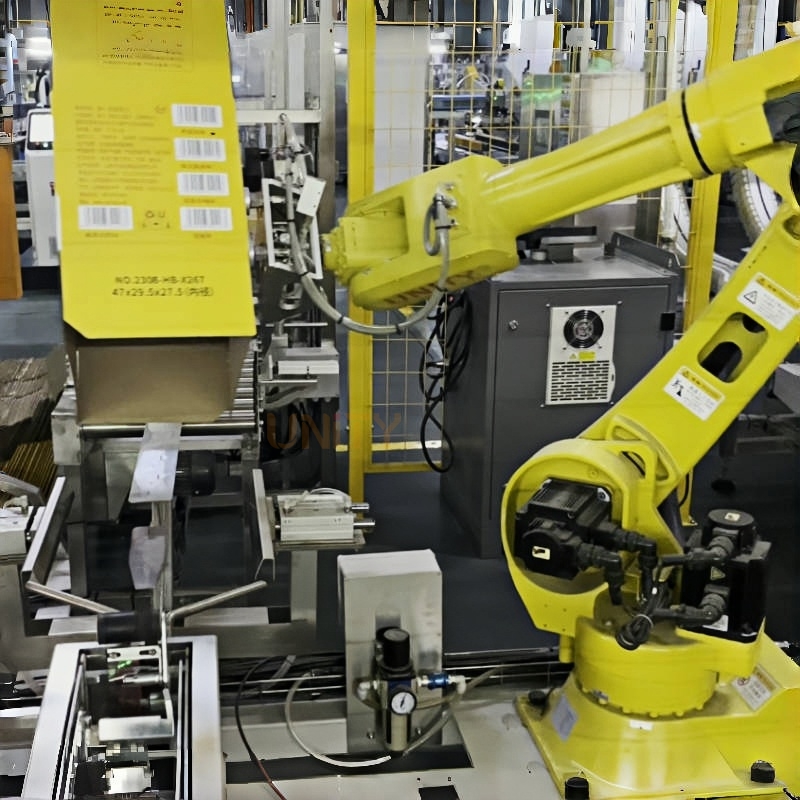
Many buyers incorrectly assume robotic integration is entirely plug-and-play. We must highlight common deployment failures immediately to dispel this dangerous myth. Proper preparation prevents disastrous commissioning delays.
Reputable integrators always require physical box samples before issuing a firm quote. They refuse to rely solely on CAD drawings. Why? Because blueprint specifications routinely differ from real-world corrugate behavior. You cannot calculate material inconsistencies on a spreadsheet.
You might encounter recycled board porosity significantly reducing vacuum grip. Recycled fibers simply do not hold suction well. Hidden manufacturer joints can cause unexpected mechanical jamming inside the magazine. Flap interference happens frequently during bottom folding sequences. Real-world physical testing reveals these unseen errors months before the machine hits your floor.
Do not ignore ambient environmental factors. Factory temperature and humidity alter corrugate rigidity significantly. High relative humidity softens cardboard drastically. This degrades the Edge Crush Test (ECT) rating. When cardboard gets soggy, vacuum cups fail to maintain a secure grip. Always map your facility's climate conditions during the initial planning phase.
Maximum efficiency requires precise system handshakes. A standalone robotic cell provides minimal value if it starves or overwhelms surrounding equipment. Focus heavily on scalability across your entire production floor.
Pacing the erector to match fluctuating upstream throughput is absolutely critical. Your robot must adapt to varying feed rates automatically using PLC signals. It should slow down when upstream supply drops and accelerate during production bursts.
Consider high-hygiene food applications. You must ensure a continuous case supply running directly from a fast-paced sausage production line. Any delay causes immediate product spoilage and costly waste. Similarly, agricultural packaging demands precise timing. Pacing downstream boxes directly from a mechanical strawberry calyx remover prevents bottlenecks. Proper synchronization preserves fresh produce quality and maximizes shelf life.
You often need additional processing operations immediately post-erection. For bulk food handling or strict pharmaceutical compliance, consider integrating a bag inserting machine. This secondary equipment ensures proper sanitary lining before the raw product ever drops into the box.
Finally, plan your long-term transition to tertiary automation. Link your erector-packer cell directly to a heavy-duty palletizing robot. Palletizers handle the heavy lifting at the very end of the line. Linking these systems creates a unified, fully automated end-of-line ecosystem. This seamless handshake eliminates forklift traffic jams and reduces manual pallet stacking injuries.
Provide your engineering team with a concrete, action-oriented checklist. They must gather this data before preparing to contact OEMs. Gathering precise data upfront significantly accelerates the procurement cycle and guarantees an accurate machine design.
Production Rates: Define both peak and nominal throughput requirements. Know your maximum burst speeds during holiday surges. Do not size the machine based solely on daily averages.
Case Hand & Orientation: Determine major and minor panel orientation exactly. Specify all flap folding directions. The OEM needs to know exactly how the box enters and exits the work cell.
Duty Cycle & Environment: Define your operating environment clearly. Choose between cleanroom stainless-steel washdown ratings or standard industrial setups. Harsh chemical washdowns require specific IP69K-rated robotic joints.
Secondary Operations: Detail your requirements for extra modular features. Ask the integrator for inline vision inspection, automated track-and-reject systems, or high-speed pamphlet insertion.
Investing in advanced robotic automation transcends replacing a single mechanical task. It essentially future-proofs your packaging line against relentless SKU proliferation and ongoing labor shortages. Traditional machines simply cannot pivot quickly enough to handle changing retail demands. Robots offer the programmatic adaptability you need to scale profitably.
Take immediate action today. Conduct a thorough internal audit of your current operations. Document your specific corrugate variations meticulously. Measure your available floor space accurately. Log your current manual changeover downtime hours. Use these hard, verifiable numbers to build a robust financial justification model. Partner with experienced integrators who demand physical box testing, and you will ensure a seamless, highly productive deployment.
A: Combined erector and packer cells compress footprints drastically compared to traditional sequential setups. You can shrink the required floor space to as little as 60" x 54". The final footprint depends directly on the chosen robotic arm's maximum reach and your required cardboard magazine capacity.
A: It eliminates manual adjustments by utilizing advanced vision sensors and adaptive End-of-Arm Tooling (EOAT). The vision system scans the incoming flat blank to determine its exact size. The EOAT then dynamically adjusts its vacuum grip points and folding mechanisms to match the specific box dimensions perfectly on the fly.
A: Yes, modern robotic systems handle retail-ready packaging effortlessly. They utilize specialized wrap-around tooling and custom end-effectors. These advanced tools distribute force evenly across the cardboard. This allows the robot to handle and fold boxes along delicate display-ready perforations without tearing or damaging the sensitive structure.


