
- All
- Product Name
- Product Keyword
- Product Model
- Product Summary
- Product Description
- Multi Field Search
Views: 0 Author: Site Editor Publish Time: 2026-08-13 Origin: Site


End-of-line packaging creates a massive bottleneck for modern manufacturing facilities. Ongoing labor shortages and high injury risks force operations managers to rethink manual stacking methods entirely. Workers performing repetitive lifting face severe ergonomic hazards over time. Facilities desperately need reliable automation to keep operations flowing safely and efficiently. This operational urgency drives many leaders to adopt a modern robotic palletizing solution. You face a critical dilemma when upgrading your packaging line. Should you install a traditional, high-speed industrial machine? Or does a newer, flexible collaborative robot make more sense for your floor plan? You must weigh these exact options carefully before committing substantial resources. We will explore an objective, data-backed comparison to guide your complex decision. You will learn exactly how to evaluate payload limits, cycle speeds, and facility footprint realities. Understanding these critical variables ensures you select the perfect automation strategy for your end-of-line process.
Payload & Speed Dictate the Baseline: Industrial robots are required for heavy, high-throughput lines; cobots excel in low-to-medium speed, lighter payload scenarios.
Footprint Matters: Cobots eliminate the need for massive safety cages, reclaiming valuable facility floor space.
TCO Goes Beyond Hardware: Industrial options have higher integration and programming costs, while cobots offer faster deployment but strict operational ceilings.
Safety & Compliance: Both systems are safe, but they achieve compliance through entirely different methods (physical guarding vs. force-limiting sensors).
To make an informed choice, we must first define the core technologies operating within these systems. You cannot treat all automated systems identically because they serve vastly different operational needs. Industrial Robots represent the traditional standard in high-volume manufacturing. Engineers design these purpose-built, high-torque machines for maximum speed and rigid repeatability. They run continuously under heavy-duty conditions without mechanical fatigue. Governed by rigid standards like ISO 10218, they excel in harsh environments requiring absolute precision and sheer power.
Conversely, Cobot Robots (collaborative robots) introduce an entirely new engineering philosophy. We define them as flexible, force-limited automation. Manufacturers build them specifically to work alongside human operators seamlessly. They operate safely without bulky physical barriers. Built-in joint torque sensors instantly halt their movement upon detecting unexpected contact, aligning seamlessly with modern safety guidelines.
Our goal is not to declare one universally better than the other. Both architectures effectively anchor a highly capable Robotic Palletizing Solution. They simply solve different production variables. Your final choice depends heavily on your unique facility constraints, output demands, and how frequently workers interact with the stacking area.
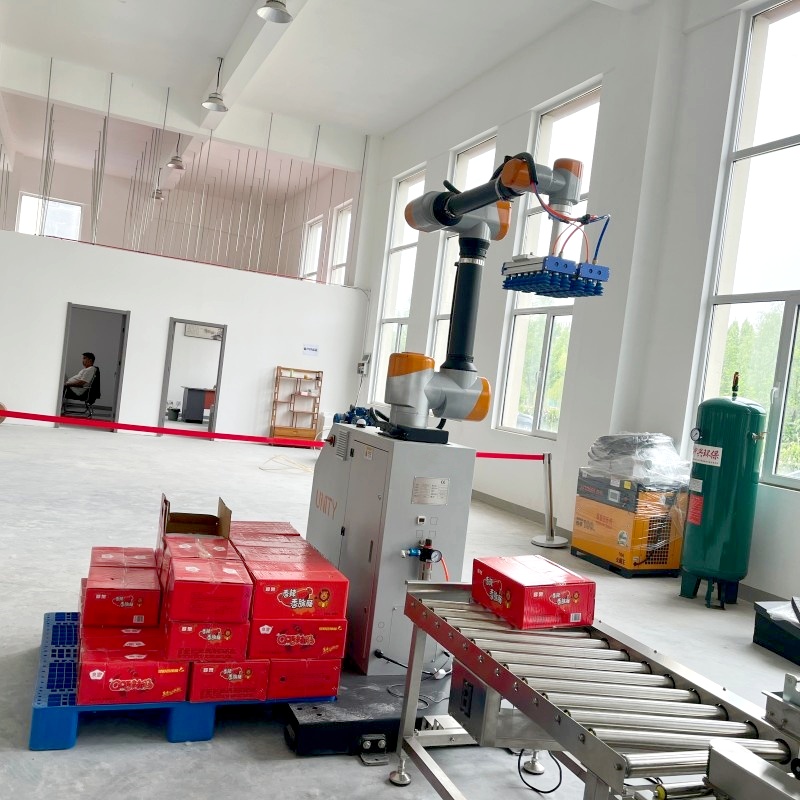
Let us break down the performance metrics. Choosing a cobot palletizer vs industrial robot palletizer requires analyzing four primary operational dimensions.
Payload dictates your initial filtering process when selecting equipment. Industrial options handle massive weights effortlessly due to their rigid cast-metal constructions and heavy-duty servomotors. These units easily manipulate heavy loads exceeding 100 to 500 kilograms. Suppose your agriculture, building materials, or chemical plant requires a robust 50kg Bag Palletizer. In such extreme cases, traditional industrial setups remain the only viable, safe option for continuous lifting.
Collaborative units follow entirely different physical limits. Engineers typically cap their maximum payloads around 20 to 30 kilograms to maintain safe momentum limits. You must always include the End of Arm Tooling (EOAT) weight in this total limit calculation. Pushing collaborative equipment to its maximum rated payload severely degrades its kinematic speed. Overloading also reduces the internal joint lifespan significantly, leading to premature wear.
Speed directly impacts daily production targets and overall factory throughput. Industrial systems dominate high-volume environments requiring relentless pacing. They routinely execute 20 to 40 picks per minute depending on travel distance. Integrators build them for continuous high-speed movement across large work envelopes. They often utilize multi-pick tooling to grab entire case rows simultaneously, drastically multiplying total throughput.
Collaborative units operate at a much calmer, controlled pace. They generally peak between 6 and 12 picks per minute in real-world applications. Strict global safety standards demand slower joint speeds to prevent dangerous impact forces. These kinematic limits protect nearby workers perfectly but inherently restrict overall packaging throughput. You must accept this speed trade-off for the benefit of cageless operation.
Space represents a premium asset inside any warehouse or production facility. Traditional automation claims a massive physical footprint. They require heavy floor anchoring and extensive structural safety fencing to isolate them from personnel. You must install complex light curtains, interlocked gates, and dedicated safety controllers. These combined safety components consume enormous amounts of valuable square footage.
Collaborative systems stay highly compact by design. You can often mount them on mobile bases, lifting columns, or minimal floor pedestals. They rely on programmable laser area scanners instead of rigid steel cages. The machine automatically slows down or pauses when human operators approach the loading zone. This modern innovation reclaims valuable aisle space and improves forklift traffic flow.
Deployment flexibility separates the two technologies sharply. Traditional cells require specialized programming knowledge and complex commissioning phases. You usually need external system integrators who understand proprietary OEM coding languages to set up the logic. Once integrators bolt the system down and calibrate the points, it remains highly static. Changing pallet patterns requires calling the integrator back for software adjustments.
Collaborative units feature highly intuitive, touch-screen teach pendants. They rely on modern no-code or low-code software interfaces that mimic smartphone applications. Your internal engineering team can redeploy them to different packaging lines quickly. You can manually guide the arm to reprogram new box dimensions and pallet patterns in mere hours, completely bypassing external integration dependencies.
Evaluating your investment extends far beyond the basic hardware specifications. We must examine how quickly you can integrate these systems into daily operations. Upfront hardware acquisition represents only the first phase of project implementation. Collaborative units generally present a more accessible entry threshold for the base equipment. You unpack them, mount them, and begin basic setup immediately. Conversely, traditional heavy-duty systems demand significant structural preparations before arrival. You must budget extensive time and resources for heavy safety guarding, electrical drops, and specialized floor reinforcement.
Maintenance models differ drastically between the two operational ecosystems. Collaborative setups empower your internal maintenance teams to handle routine troubleshooting and pattern adjustments. This local autonomy accelerates uptime recovery dramatically. Traditional automated cells may require scheduling external technician visits for software tweaks or complex mechanical servicing, extending potential downtime.
Return on investment timelines favor different business operational models. Collaborative setups often achieve a full operational return in just 9 to 14 months. Their highly streamlined integration and minimal infrastructure requirements drive this rapid payback. Traditional solutions typically require 18 to 24 months to break even entirely. However, they scale far better for relentless, high-volume production schedules over a ten-year lifespan.
Every automation project carries distinct integration challenges. You must proactively manage several technical risks to ensure smooth deployment.
Risk 1: Overestimating Speed Capabilities
Many buyers mistakenly assume a collaborative unit can match human burst speeds during peak hours. You must avoid this common conceptual error. Force-limiting safety features inherently throttle joint velocity to maintain safe impact thresholds. If your packaging line demands sudden, rapid surges in stacking speed, a collaborative unit will quickly fall behind. Integrators cannot magically override these hard-coded safety limits. You must plan for steady, continuous flow rather than burst capacity.
Risk 2: Tooling Weight Miscalculations
Operators frequently forget about the sheer mass of the gripper. You must remember that the End of Arm Tooling weight subtracts directly from the total lifting capacity. A heavy vacuum array and its pneumatic valves could consume five kilograms of a twenty-kilogram limit. This miscalculation drastically reduces the actual product weight you can legally move. You must audit your gripper specifications early in the design phase to avoid unexpected lifting failures.
Risk 3: Facility Layout and Traffic Flow Changes
Traditional machines remain bolted firmly in place forever. While their static nature implies mechanical stability, it greatly complicates warehouse logistics. Bringing heavy forklifts close to traditional safety cages requires careful layout planning. A minor forklift collision with a steel safety fence can trigger safety circuit emergency stops, halting production for hours. You must allocate wider aisle dimensions to prevent these accidental collisions entirely.
We must consolidate these complex variables into an actionable choice. Use the following criteria to evaluate your specific packaging line constraints accurately.
Choose a Collaborative Architecture if:
Your overall throughput remains strictly under 10 to 12 cases per minute.
Your product payloads are consistently under 20 kilograms, including tooling.
Your facility floor space is severely restricted, congested, or awkwardly shaped.
You need to handle a high mix of shifting SKUs across multiple different lines.
Choose an Industrial Architecture if:
Your throughput requirements exceed 15 cases per minute regularly.
Your payloads are massive, requiring heavy-duty vacuum or mechanical grippers.
Your production line runs 24/7 handling a low mix of highly standardized SKUs.
Your facility space accommodates large safety perimeters without impeding forklift traffic.
Palletizing System Comparison Matrix
Performance Metric | Collaborative System | Traditional System |
|---|---|---|
Maximum Rated Payload | Up to 30 kg | 100 - 500+ kg |
Operational Speed (CPM) | 6 to 12 picks | 20 to 40+ picks |
Required Safety Guarding | Area Scanners (Cage-free) | Steel Fencing & Light Curtains |
Programming Interface | Low-code / Teach Pendant | Proprietary OEM Language |
Redeployment Flexibility | High (Mobile potential) | Low (Fixed to floor) |
Selecting the ideal automation strategy requires deep, careful analysis. The ongoing debate between a cobot palletizer vs industrial robot palletizer ultimately comes down to basic physics and mathematics. You must accurately weigh your exact payload, desired cycle speed, and available factory footprint.
Collaborative units offer incredible flexibility and immense space savings for lighter, slower tasks. They democratize automation for smaller facilities. Traditional heavy-duty machines deliver unmatched speed and unyielding reliability for massive payloads. They form the unbreakable backbone of massive distribution centers.
Your next step involves precise data collection. We strongly encourage you to conduct a comprehensive line audit before requesting external quotes. Follow this basic checklist:
Calculate your exact maximum box weights.
Determine the heavy weight of necessary end-of-arm tooling.
Measure your true cases per minute during peak seasonal shifts.
Map out your available square footage using accurate floor blueprints.
Assess the frequency of human interaction required near the stacking zone.
Gathering this objective data ensures you request the right system architecture and avoid disastrous implementation mistakes.
A: Yes, and often better than traditional industrial options. Their software allows for easier reprogramming and seamless advanced vision system integrations. You can build complex, mixed-pattern pallets rapidly, provided you strictly respect the overall speed and payload limits of the collaborative arm.
A: Mostly, but comprehensive risk assessments remain legally required. If the arm handles sharp objects or operates near heavy forklift traffic, you must implement minor safeguarding. Relying on safety-rated area scanners usually suffices, keeping the footprint much smaller than rigid steel cages.
A: Collaborative setups offer rapid deployment, often launching in just one to three weeks. You simply roll them in and train the software waypoints. Traditional industrial cells typically require eight to sixteen weeks. They demand custom integration, heavy safety fencing construction, and specialized logic programming.


