
- All
- Product Name
- Product Keyword
- Product Model
- Product Summary
- Product Description
- Multi Field Search
In today’s high-speed manufacturing environment, packaging accuracy is no longer optional—it is essential. Carton misalignment, inconsistent folding, and sealing errors can lead to damaged goods, delayed shipments, and increased operational costs. As production volumes grow and labor availability fluctuates, many factories are turning to automation to stabilize performance. Among the most impactful technologies transforming packaging lines is the box erector robot.
A box erector robot is designed to automatically form, square, and prepare cartons for product loading. While the concept may sound straightforward, the precision engineering behind modern robotic case erecting systems delivers measurable improvements in accuracy, repeatability, and overall line consistency. From flat carton feeding to final box forming, every movement is controlled, calibrated, and monitored.
At Shandong Unity Robotics Co., Ltd., we design and manufacture advanced box erector robot systems tailored for industrial packaging lines. In this article, we explain how a box erector robot enhances accuracy and consistency, why this matters for your production line, and what technical features make the difference.
Before discussing robotic solutions, it is important to understand common challenges in traditional carton erecting processes.
Manual or semi-automatic methods often result in:
Inconsistent folding angles
Uneven carton squaring
Glue or tape misalignment
Variable compression during forming
Operator fatigue affecting output quality
When cartons are not properly squared, downstream systems—such as case packers or palletizers—experience alignment problems. This creates bottlenecks and reduces overall efficiency.
Even minor dimensional inconsistencies can lead to:
Poor stacking stability
Damaged products during transport
Increased packaging material waste
Rework and rejection rates
This is where a box erector robot introduces measurable improvements.
A box erector robot improves accuracy through advanced programmable motion control systems that eliminate the unpredictability of manual forming. Unlike traditional carton erection methods, where human operators rely on visual judgment and repetitive physical motion, robotic systems operate based on digitally calibrated coordinates and synchronized mechanical sequences.
Each movement in a box erector robot is pre-programmed, monitored, and adjusted through servo motors and PLC-based control systems. This ensures that the folding, squaring, and sealing process remains identical from the first carton to the ten-thousandth.
Key precision elements include:
Servo-driven folding mechanisms that guarantee exact flap positioning
Controlled suction pick-and-place systems that prevent skewed carton blanks
Automated carton squaring sensors that verify geometric alignment
Calibrated compression timing to ensure secure bottom sealing
Because every mechanical movement is measured and repeatable, human variability is completely removed from the forming stage.
Performance Factor | Manual Forming | Box Erector Robot |
Folding consistency | Variable | Highly consistent |
Carton squareness | Operator dependent | Mechanically controlled |
Repeatability | Moderate | Extremely high |
Speed stability | Fluctuating | Constant |
Error rate | Higher | Significantly reduced |
By standardizing every movement, the box erector robot ensures each carton is formed identically—cycle after cycle. This consistency improves downstream synchronization and minimizes disruptions in high-speed production lines.
One of the most overlooked sources of inaccuracy in packaging lines is improper flat carton feeding. If carton blanks are even slightly misaligned before entering the forming station, the entire erection sequence becomes unstable. This leads to uneven folding, skewed squaring, and sealing inconsistencies.
Modern box erector robots are designed to address this issue at its source.
Key feeding technologies include:
Automatic carton magazines that maintain stable stack alignment
Adjustable feeding rails that accommodate varying carton sizes
Vacuum suction precision pickup systems that ensure consistent engagement
Misfeed detection sensors that prevent defective blanks from entering the forming cycle
These systems ensure that every carton blank enters the forming station in the correct orientation, angle, and timing position.
Feeding precision directly influences overall production stability. When blanks are consistently aligned, forming accuracy improves automatically.
Benefits of consistent feeding:
Reduced jam frequency
Stable cycle timing
Improved glue or tape alignment
Lower maintenance interruptions
Reduced mechanical wear
In high-volume production environments, even minor feeding inconsistencies can create cumulative inefficiencies. By stabilizing the input stage, the box erector robot protects the entire packaging workflow.
Carton squareness plays a crucial role in packaging integrity. A box that appears acceptable visually may still have slight geometric deviations that compromise stacking stability and load distribution.
If cartons are not perfectly squared:
Pallets may lean or collapse
Adhesive bonds may weaken
Products may shift during transit
Warehouse stacking becomes unstable
A box erector robot improves squaring accuracy through integrated mechanical control and dimensional verification systems.
Structural precision features include:
Multi-point mechanical alignment guides for controlled geometry
Sequenced bottom flap folding mechanisms for balanced formation
Adjustable compression arms for uniform pressure application
Real-time dimensional verification sensors for quality control
Unlike manual forming, which relies on operator force and speed, robotic compression applies consistent pressure at calibrated intervals. This ensures that each corner, edge, and seam aligns properly before sealing.
Issue from Poor Squaring | Operational Impact |
Uneven load distribution | Box collapse risk |
Misaligned sealing | Tape/glue waste |
Poor stacking | Pallet instability |
Product movement | Damage during transport |
By ensuring uniform geometry, the box erector robot strengthens downstream packaging integrity. Proper squaring not only enhances shipping safety but also improves compatibility with case packers, labeling systems, and palletizers.
Inconsistent adhesive application is another source of variability.
Manual processes may result in:
Over-gluing
Under-gluing
Misplaced tape
Incomplete sealing
A box erector robot integrates controlled sealing systems:
Programmable glue bead length
Adjustable temperature controls
Consistent tape tension
Automated flap hold-down timing
These features ensure that every carton receives identical sealing conditions, improving structural reliability.
Consistency is not just about dimensional accuracy—it also involves stable production rates.
Manual forming may vary depending on:
Operator speed
Fatigue levels
Shift changes
Environmental conditions
A box erector robot maintains:
Fixed cycle time
Predictable throughput
Continuous operation capability
Real-time performance monitoring
Stable cycle time allows better synchronization with upstream and downstream systems such as case packers and palletizers.
Modern box erector robots are equipped with diagnostic systems to further enhance consistency.
Advanced systems include:
Carton presence detection
Fault alarms
Sensor-based alignment checks
Automatic rejection of malformed cartons
By identifying issues early, the robot prevents defective cartons from entering the packing stage.
This reduces:
Rework costs
Downtime
Customer complaints
Shipping damage claims
Automation adds a layer of quality assurance that manual processes cannot consistently deliver.
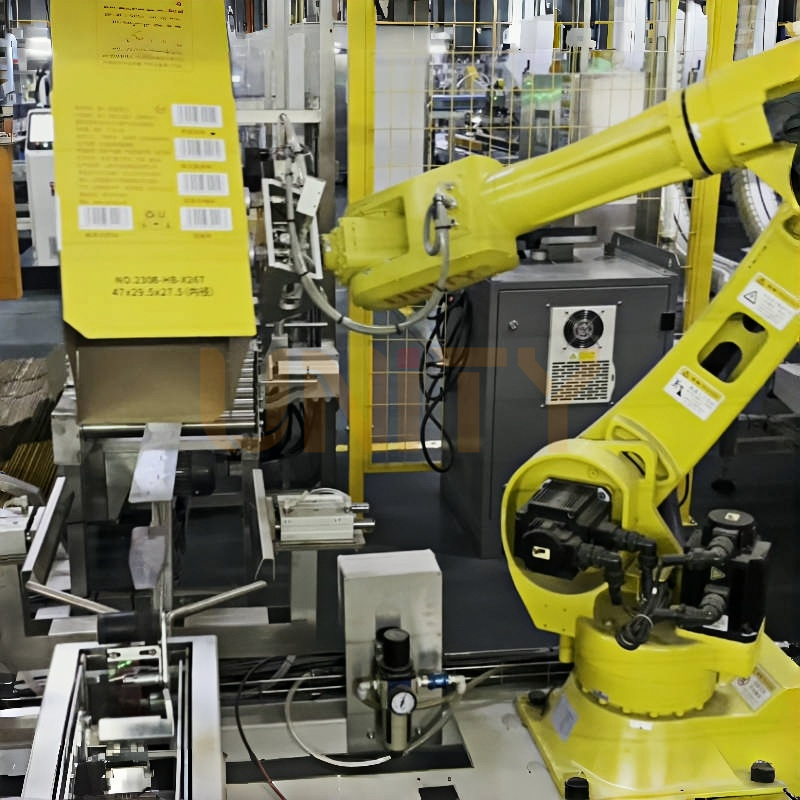
Accuracy improves further when the box erector robot is integrated with:
Case packer robots
Conveyor synchronization systems
Palletizing robots
Vision inspection units
Full-line integration eliminates timing mismatches.
Benefits include:
Smooth carton transfer
Reduced idle time
Uniform spacing between cartons
Optimized overall line efficiency
A properly integrated box erector robot becomes the foundation of packaging line stability.
Unlike manual labor, robotic systems do not experience fatigue, training inconsistencies, or performance decline over time.
Long-term consistency advantages include:
Predictable production planning
Stable output quality across shifts
Reduced human dependency
Lower variability in KPI metrics
This makes automation particularly valuable for factories operating multiple shifts or handling export packaging standards.
Improved accuracy and consistency translate into measurable financial benefits.
Improvement Area | Financial Effect |
Reduced carton waste | Lower material costs |
Fewer damaged goods | Lower claim rates |
Stable throughput | Higher productivity |
Reduced labor variability | Predictable labor cost |
Improved pallet stability | Lower logistics risk |
Over time, these savings offset the initial investment in a box erector robot.
At Shandong Unity Robotics Co., Ltd., we design box erector robot systems with precision engineering as the primary objective. Accuracy and consistency are not optional performance features—they are the core design principles.
Our engineering approach focuses on:
Servo-controlled motion accuracy
Stable mechanical squaring systems
Intelligent feeding design
Seamless integration capability
We understand that packaging reliability directly affects brand reputation, logistics stability, and customer satisfaction.
Rather than simply increasing speed, we prioritize repeatability, structural integrity, and long-term durability in every box erector robot system we produce.
For factories seeking measurable improvements in packaging accuracy and consistency, we invite you to learn more about our solutions at Shandong Unity Robotics Co., Ltd.
A box erector robot uses servo-controlled folding and squaring mechanisms to ensure every carton is formed with consistent geometry and sealing precision.
Yes. By minimizing misalignment and adhesive errors, it significantly reduces material waste and rejected cartons.
Absolutely. It maintains stable cycle times and integrates seamlessly with automated case packers and palletizers.
No. While the box erector robot automates forming tasks, trained personnel monitor performance and maintain system optimization.