
- All
- Product Name
- Product Keyword
- Product Model
- Product Summary
- Product Description
- Multi Field Search
If you manage a high-volume production line, you already know that packaging is rarely “just the last step.” It’s often the step that decides whether you ship on time, whether labor stays stable, and whether your output is consistent shift after shift. And among all packaging tasks, one of the most underestimated bottlenecks is box forming—taking flat cartons, erecting them into usable cases, squaring them, and sealing the bottom reliably enough for downstream loading and transport.
That’s exactly why more manufacturers are turning to a box erector robot. When your line speed increases, the cost of small packaging delays becomes huge: a few seconds lost per case becomes hours per week; a small squaring defect becomes a jam; a tape misalignment becomes a rework loop. A box erector robot transforms box forming from a manual, variable process into a controlled, repeatable operation that keeps pace with modern production and distribution demands.
In this article, we’ll explain what makes a box erector robot “essential” (not just “nice to have”) in high-volume environments. We’ll look at the operational problems it solves, the metrics it improves, how it fits into real packaging lines, and what you should evaluate before specifying one.
A box erector robot is an automated system that takes flat box blanks from a magazine, opens and squares them, folds the bottom flaps, and seals the bottom—typically using tape or hot-melt glue—so the case is ready for filling. In many factories, it’s installed upstream of:
case packers (robotic or mechanical)
cartoners and baggers that discharge into cases
manual or semi-automatic packing stations
end-of-line palletizing
When we talk about “robot,” some customers imagine a fully articulated arm. In reality, box erecting systems may combine robotic handling, servo-driven motion, vacuum pick-up, and automated flap folding. The key is not the shape of the machine—the key is the outcome: consistent case erection at production speed.
High-volume production magnifies small inefficiencies. Box erection becomes a bottleneck for three core reasons:
A trained worker can erect boxes quickly—but speed fluctuates with fatigue, shift changes, training level, and work conditions. In high-volume settings, the required pace becomes difficult to sustain consistently.
Cases that are slightly out-of-square, poorly sealed, or inconsistently formed lead to:
jams at loading stations
mis-picks by case packers
collapsed cases during transport
uneven stacking on pallets
Manual box forming is repetitive, physically demanding, and often high-turnover. High-volume operations typically face:
staffing uncertainty
training time
injury risk
inconsistent output quality
A box erector robot directly addresses these realities by stabilizing the first step of case handling.
In high-volume production, the line’s real enemy is not one big failure—it’s hundreds of small interruptions. Manual erection can introduce frequent micro-stops:
waiting for erected cases
correcting poor folds
re-taping bottom seams
clearing small jams caused by poor squaring
A box erector robot supplies erected cases at a predictable rhythm, helping downstream equipment run smoothly.
Automation downstream (case packing, labeling, palletizing) depends on consistent case geometry. A box erector robot:
squares cases consistently
aligns flaps correctly
seals the bottom in the same position each cycle
That consistency reduces reject rates and improves overall equipment effectiveness (OEE).
A common misconception is that automation is only about “replacing people.” In practice, a box erector robot helps you:
move labor away from repetitive tasks
reduce overtime caused by packaging constraints
allocate staff to quality checks, replenishment, coordination, and line supervision
This supports productivity while making staffing more resilient.
Box forming involves repetitive bending, twisting, lifting, and taping motions. Over time, these tasks can contribute to strain injuries. A box erector robot reduces exposure to repetitive motion and improves workstation ergonomics—an important factor in high-volume environments.
If your order volume increases, adding more manual erecting labor may not be a stable solution. A box erector robot gives you a scalable foundation that can match increased throughput—often with minimal changes to your layout.
From our project experience, box erector robots show the strongest ROI in scenarios like:
high SKU throughput with frequent case use
multi-shift operations (especially 2–3 shifts)
e-commerce fulfillment where packaging volume is steady and time-sensitive
food, beverage, and daily chemical plants with large output and strict consistency
pharma and medical supplies where packaging integrity is critical
contract packaging (co-packers) where labor variability is a constant challenge
When production runs continuously, even modest efficiency gains translate into large cost improvements.
Here’s a clearer view of what changes after installation:
Operational Metric | Before Automation (Typical Issue) | After Box Erector Robot (Typical Improvement) |
Throughput stability | Fluctuates by shift and staffing | More consistent case supply rate |
Case squareness | Variable, causes jams | Repeatable geometry improves flow |
Sealing quality | Tape misalignment or weak seals | More uniform sealing and fewer failures |
Downtime | Micro-stops and rework loops | Reduced interruptions upstream |
Labor efficiency | High repetitive workload | Labor reallocated to higher-value tasks |
Packaging integrity | Occasional collapse or deform | Improved strength and transport reliability |
These improvements are not theoretical—they are the kinds of outcomes that typically show up in daily operations.
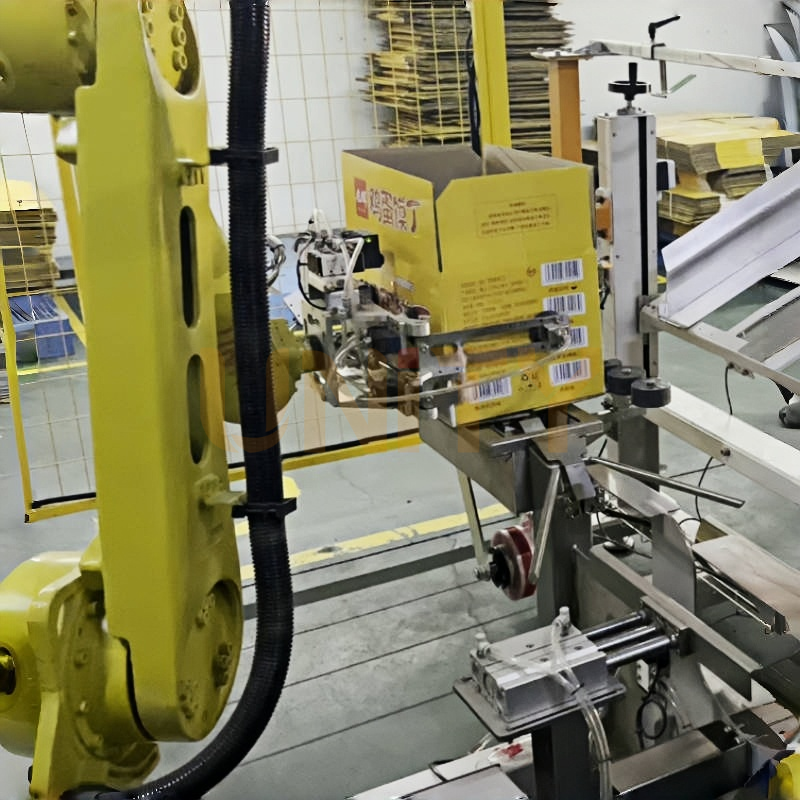
A box erector robot is often the beginning of an end-of-line system that may include:
Box erection (your case starts here)
Case packing (robotic or mechanical loading)
Case sealing (top sealing)
Labeling / coding
Checkweighing / inspection (if required)
Palletizing (robotic or conventional)
When box erection is stable, every downstream step becomes easier to automate and optimize.
To ensure the system truly becomes “essential” rather than “another machine,” we recommend focusing on these decision factors:
How many cases per minute do you need?
Do you need accumulation to absorb upstream/downstream variation?
Single size all day or multiple sizes per shift?
Is changeover manual, semi-auto, or recipe-based?
Tape is common and convenient
Hot-melt can be preferred for certain environments or carton types
Your product mix and logistics conditions usually decide the best approach.
Case erection reliability also depends on the boxes themselves:
board stiffness
die-cut accuracy
moisture exposure during storage
A good solution accounts for real carton variability rather than assuming perfect materials.
A box erector robot should align with:
conveyor height and case flow direction
case packer infeed rhythm
plant safety standards and maintenance access
Integration is where many projects win or lose long-term success.
A box erector robot becomes essential for high-volume production because it stabilizes one of the most foundational steps in packaging: forming cases that are square, sealed, and ready at the exact pace your line demands. It protects throughput by reducing micro-stops, increases consistency for downstream automation, improves sealing reliability, lowers repetitive labor dependency, and supports safer, more scalable operations. In high-volume environments, these improvements don’t just “help”—they often determine whether your packaging line is a bottleneck or a competitive advantage.
At Shandong Unity Robotics Co., Ltd., we design automation solutions with a practical focus: stable performance, real-world carton handling, and smooth integration into high-output production lines. If you’re planning to upgrade your packaging workflow—or if your current manual box forming is limiting capacity—we welcome you to learn more about our box erector robot solutions. You can contact our team to discuss your box sizes, target speeds, layout constraints, and automation goals, and we’ll share configuration ideas that fit your production reality.
1) What industries benefit most from a box erector robot?
High-volume sectors such as food and beverage, daily chemicals, e-commerce fulfillment, pharmaceuticals, and contract packaging benefit the most due to throughput demands and consistency needs.
2) Can a box erector robot handle multiple box sizes?
Yes. Many systems support a range of carton sizes. The key is evaluating how often you change sizes and how quickly changeovers can be completed.
3) Does a box erector robot reduce carton sealing failures?
Typically yes. Automated flap folding and consistent tape or glue application reduce misalignment, weak seals, and rework compared to manual forming.
4) How do I know if my line truly needs a box erector robot?
If manual box forming causes waiting, micro-stops, inconsistent case quality, or staffing pressure—especially across multiple shifts—automation is often justified and can quickly become essential for maintaining throughput.